
Your system can’t afford a storage failure at -35°C on the factory floor. Neither can an autonomous vehicle platform lose data mid-operation, or an aerospace data recorder miss a write cycle during peak vibration. Industrial SSDs exist precisely because commercial-grade drives weren’t built for these conditions – and the specification gap between the two is larger than most product teams realize.
Industrial solid state drives are purpose-built storage components rated for extended temperature operation, high shock and vibration tolerance, write-intensive workloads, and long deployment lifecycles. They’re the storage layer underneath automation systems, ADAS platforms, edge computing nodes, and mission-critical data recorders where drive failure isn’t a support ticket – it’s a production shutdown or a safety event.
This guide breaks down what separates industrial SSDs from consumer alternatives, which NAND types match which workloads, how to read the specs that matter, and what applications drive demand across manufacturing, automotive, aerospace, and defense sectors.
What Makes an SSD “Industrial Grade”?
The term industrial grade refers to a defined set of performance and environmental specifications – not a marketing category. Industrial SSDs are differentiated from commercial and consumer drives across four measurable dimensions.
Extended Temperature Range
Consumer SSDs typically operate within 0°C to +70°C. Industrial SSDs are rated for -40°C to +85°C as a baseline, with some products supporting extended ranges up to +105°C for automotive and high-ambient deployments. This temperature window aligns with the AEC-Q100 automotive qualification standard, which specifies operating conditions for electronic components used in vehicle systems.
The temperature tolerance gap matters because commercial drives can throttle, produce uncorrectable errors, or fail outright when exposed to temperature extremes. An industrial SSD maintains data integrity and specified read/write performance across that full thermal envelope without operator intervention.
Shock and Vibration Ratings
Industrial SSDs carry rated shock and vibration tolerances tested per standards such as MIL-STD-810 for military and defense applications or IEC 60068 for general industrial environments. Typical industrial SSD shock specifications run up to 1,500G at 0.5ms half-sine pulse. Vibration ratings commonly reach 20G across relevant frequency ranges.
These are not estimates – they’re tested values from qualification programs. When an industrial SSD datasheet lists a vibration rating, that figure comes from documented test results, not extrapolation from consumer product data.
Write Endurance and NAND Selection
Industrial SSDs specify endurance in drive writes per day (DWPD) or total bytes written (TBW) over a rated operational lifespan – typically 5 to 10 years. The NAND type selected for a drive directly determines its endurance ceiling.
- SLC (Single-Level Cell): Stores one bit per cell. Endurance typically reaches 50,000 to 100,000 program/erase (P/E) cycles. Best fit for write-intensive, mission-critical workloads where cost per gigabyte is secondary to drive longevity.
- pSLC (Pseudo-SLC): MLC or TLC NAND operated in SLC mode via firmware control. Delivers meaningfully higher endurance than native MLC operation at lower cost than true SLC. A common selection for automotive TCU and industrial gateway applications that require durability without the full SLC cost premium.
- MLC (Multi-Level Cell): Stores two bits per cell. Endurance ranges from 3,000 to 10,000 P/E cycles. Appropriate for read-heavy industrial applications with moderate write frequency.
- TLC (Triple-Level Cell): Stores three bits per cell, 1,000 to 3,000 P/E cycles. Suitable for high-capacity, lower-write-intensity applications such as video surveillance and data archiving where cost per gigabyte matters more than maximum endurance.
Choosing the wrong NAND type for a workload is one of the most common specification errors in embedded storage design. An industrial SSD built on TLC NAND won’t meet the write demands of a write-intensive factory automation system regardless of other design features. For a full endurance and cost-per-gigabyte comparison, see SLC, MLC, TLC, and QLC NAND for industrial applications.
Power Loss Protection
Power interruptions during write operations are a leading cause of data corruption in flash storage. Industrial SSDs address this with onboard capacitor-backed power loss protection (PLP) circuits. When power drops unexpectedly, the capacitor supplies enough energy to flush in-flight writes and update mapping tables before the drive powers down completely. This feature is mandatory for applications in manufacturing, automotive, and critical infrastructure where uncontrolled shutdowns are operationally realistic.
Industrial SSD Interface Standards: SATA, NVMe, and Form Factor Considerations
Interface selection affects sequential and random I/O performance ceilings, power consumption, and physical integration requirements. Industrial SSDs ship across several interface standards – each with different trade-off profiles for embedded and industrial applications.
SATA III
SATA III delivers sequential read speeds up to 600 MB/s and remains the dominant interface for cost-sensitive industrial deployments where throughput requirements don’t exceed its ceiling. The interface’s maturity, broad controller support, and lower power draw make it a practical selection for factory automation, medical device storage, and surveillance applications. Lexar Enterprise’s UNCIA 3839 Enterprise SATA III SSD is designed for these industrial operating conditions, supporting the sustained workloads and environmental demands that commercial SATA drives aren’t rated to handle.
NVMe over PCIe
NVMe protocol over PCIe lanes reduces command queue depth limitations and eliminates the AHCI bottleneck that constrains SATA throughput. Industrial NVMe SSDs can deliver sequential read speeds exceeding 3,500 MB/s and dramatically lower latency than SATA alternatives. For real-time ADAS sensor data fusion, high-speed machine vision systems, and edge AI inference platforms where storage latency feeds directly into system response time, NVMe is often the only viable interface choice. Lexar Enterprise’s XP-series PCIe SSDs – including the XP2300 and XP2000 – address industrial PCIe deployments requiring high throughput with industrial-grade reliability.
Form Factor Selection
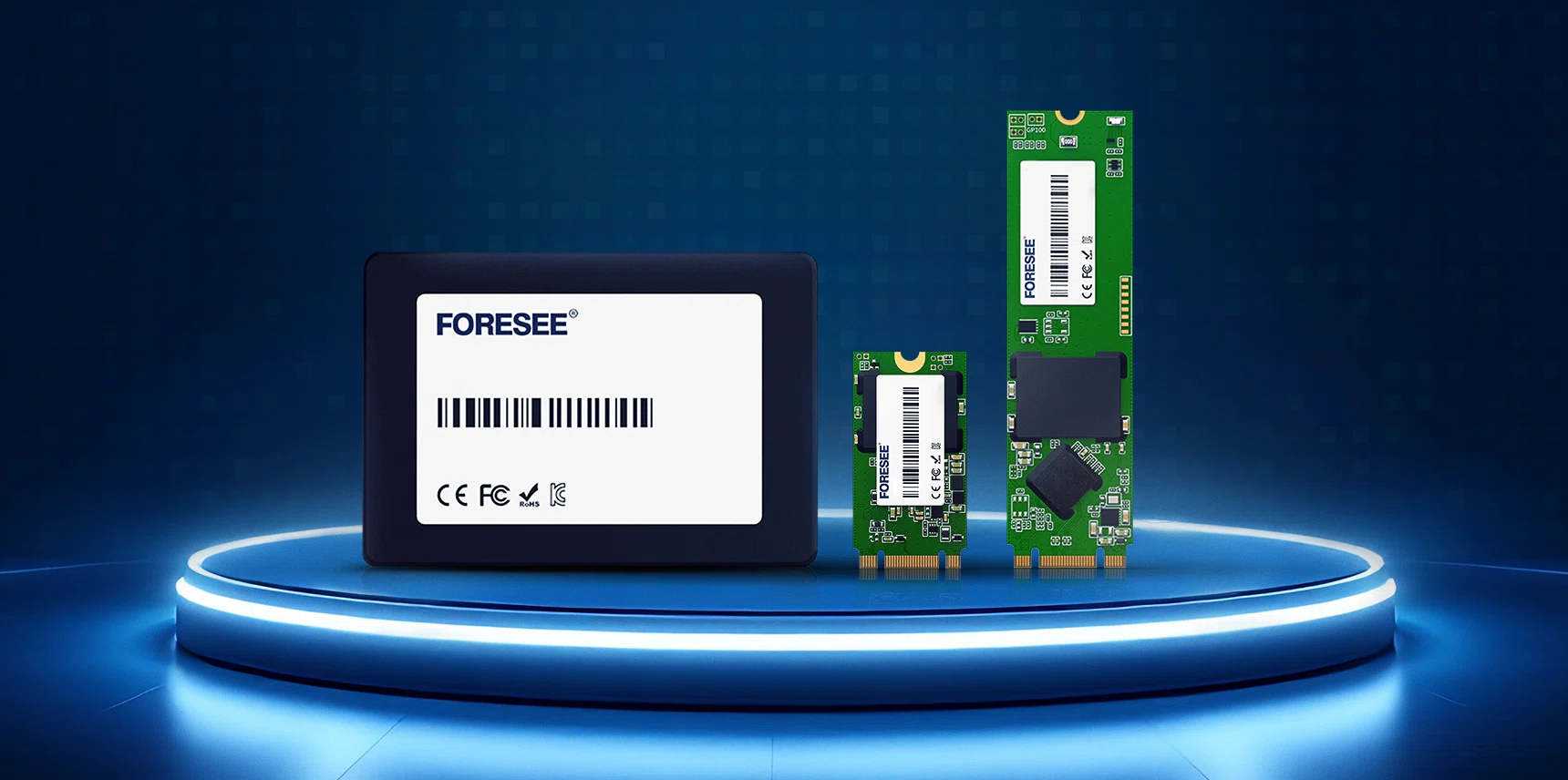
Industrial SSDs ship in M.2 2242/2280, 2.5-inch, and half-slim form factors. M.2 dominates embedded and automotive applications due to its compact footprint and direct board mounting. 2.5-inch drives remain common in rackmount industrial systems where connector compatibility and hot-swap capability matter. Form factor selection must account for board clearance, connector type (M-key, B-key, SATA), and thermal management constraints specific to the enclosure design.
Industrial SSD Applications by Sector
Industrial SSDs serve different functional roles across sectors. The requirements aren’t uniform – a manufacturing automation controller has different storage demands than an aerospace flight data recorder, even though both qualify as industrial deployments.
Automotive and ADAS
Advanced Driver Assistance Systems generate continuous sensor data from radar, cameras, and LIDAR arrays that must be stored and processed in real time. The storage subsystem in an ADAS platform runs under sustained write loads, experiences engine bay temperature cycling, and must maintain data integrity through vibration profiles that would accelerate wear in commercial drives. Industrial SSDs specified for automotive applications typically meet AEC-Q100 qualification and operate across the -40°C to +85°C (or +105°C) temperature range required for under-hood or near-chassis deployment.
Telematics control units (TCUs) and in-vehicle infotainment (IVI) systems present a parallel set of requirements – lower write intensity than ADAS but strict longevity requirements tied to vehicle service life. For these applications, pSLC or MLC NAND in industrial-grade form typically provides the right endurance-to-cost ratio. Learn more about Lexar Enterprise’s automotive storage solutions across ADAS, TCU, and IVI platforms.
Manufacturing and Factory Automation
Programmable logic controllers (PLCs), edge gateways, and HMI systems on factory floors operate in environments with sustained vibration from machinery, temperature swings from ambient to process heat, and power quality that includes brownouts and surges. Industrial SSDs in these deployments need power loss protection as a baseline feature – not an option. Write endurance requirements vary significantly by application: A data logging gateway writing sensor values every second runs a very different storage workload than a PLC that writes configuration data infrequently but requires absolute data integrity.
Aerospace and Defense
Aerospace and defense applications represent the most demanding end of industrial SSD requirements. Avionics systems require storage that meets DO-160 environmental test conditions for temperature, vibration, humidity, and altitude. Defense applications frequently specify MIL-STD-810 compliance for shock, vibration, and thermal cycling. Data recorders and mission computers may also require hardware-level security features including AES-256-bit encryption and cryptographic erase to meet government data protection requirements. The GSC data shows “industrial SSD aerospace” ranking at approximately position 14 – a cluster of users with very specific needs that a well-structured resource can address directly.
Edge Computing and IoT
Edge nodes deployed in remote locations – power substations, oil and gas facilities, transportation infrastructure – face combined challenges of temperature extremes, limited maintenance access, and years-long deployment without drive replacement. Industrial SSDs for edge applications prioritize a combination of extended temperature range, low power consumption, and write endurance sufficient to last the full deployment window without wear-out. Power loss protection is critical here because grid power at remote sites is frequently unreliable. See choosing the right SSD for power-conscious edge applications for a more detailed breakdown of storage selection at the edge.
Healthcare and Medical Devices
Medical imaging equipment, patient monitoring systems, and diagnostic devices require storage that delivers consistent performance without unexpected latency spikes that could affect system operation. Industrial SSDs in medical applications often need to meet FDA regulatory documentation requirements for component traceability and must support secure erase to comply with HIPAA data management obligations when devices are serviced or decommissioned.
How to Evaluate Industrial SSDs: The Specification Checklist Engineers Use
Comparing industrial SSDs across vendors requires looking at the same parameters every time. Marketing language doesn’t substitute for datasheet numbers – and the checklist below reflects the questions design engineers actually ask during component evaluation.
- Operating temperature range: Confirm the minimum and maximum operating temperature against your worst-case deployment environment. Check both operating and storage temperature ratings – they’re different values on the datasheet.
- NAND type and grade: Identify whether the drive uses SLC, pSLC, MLC, or TLC NAND – and whether the NAND is industrial-grade or consumer-grade NAND in an industrial enclosure. The distinction affects endurance directly.
- Endurance rating (DWPD or TBW): Calculate whether the rated endurance covers your expected write workload across the full deployment lifetime. Undersized endurance leads to early wear-out; oversized endurance adds unnecessary cost.
- Power loss protection: Confirm onboard capacitor-backed PLP is present if your application experiences uncontrolled power-down events. Verify whether PLP covers all data paths or only specific write states.
- Shock and vibration ratings: Match the drive’s rated G-force tolerances and vibration frequency range against your application’s mechanical environment specifications.
- Error correction capability: Review the ECC algorithm (LDPC is now standard in most industrial-grade controllers) and confirm it meets your application’s data integrity requirements at the target temperature range.
- Interface and form factor: Verify electrical and physical compatibility with your board design before finalizing selection. PCIe generation, lane count, and M.2 key type all affect system integration.
- Compliance certifications: Identify required certifications for your application – AEC-Q100 for automotive, MIL-STD-810 for defense, DO-160 for aerospace – and confirm the vendor can provide the relevant test documentation.
- Lifecycle availability commitment: For multi-year production programs, confirm the vendor’s product longevity policy. Industrial customers need component availability aligned to their product roadmaps – not consumer product release cycles.
- Security features: For applications subject to data protection requirements, confirm AES-256-bit hardware encryption, TCG Opal compliance, and cryptographic secure erase support.
Industrial SSD vs. Commercial SSD: Why the Distinction Matters for System Design
Some product teams try to reduce BOM cost by substituting commercial or consumer-grade SSDs into industrial deployments. The specification gaps below explain why that substitution creates downstream risk.
| Specification | Consumer SSD | Industrial SSD |
|---|---|---|
| Operating Temperature | 0°C to +70°C | -40°C to +85°C (or +105°C) |
| NAND Grade | Consumer-grade TLC or QLC | Industrial-grade SLC, pSLC, or MLC |
| Endurance (P/E Cycles) | 150 to 3,000 typical | 3,000 to 100,000 depending on NAND |
| Power Loss Protection | Not standard | Capacitor-backed PLP standard |
| Shock Rating | Not independently qualified | Rated per MIL-STD-810 or IEC 60068 |
| Lifecycle Availability | Consumer product cycles (1-3 years) | Extended availability (5-10 years) |
| Compliance Documentation | Consumer certifications only | AEC-Q100, MIL-STD, industry-specific |
The cost difference between a consumer SSD and an industrial SSD is real. So is the cost of a field failure, a production line stoppage, or a compliance audit that finds non-spec components in a certified system. The component selection decision needs to weigh both sides of that equation.
Lexar Enterprise Industrial SSD Solutions
Lexar Enterprise designs and manufactures industrial SSDs built for the specification requirements that embedded and industrial applications actually impose – not estimated from consumer product lines. The SSD portfolio covers both SATA III and PCIe NVMe interfaces, with industrial-grade NAND flash, onboard power loss protection, and extended temperature operation.
- XP1000 PCIe SSD: Industrial NVMe via PCIe, designed for high-throughput embedded and edge computing applications.
- XP2000 PCIe SSD: Higher-performance PCIe platform for ADAS, machine vision, and data-intensive industrial applications.
- XP2300 PCIe SSD: Extended capacity industrial NVMe SSD for applications requiring high-density storage at industrial specification.
- UNCIA 3839 Enterprise SATA III SSD: Industrial SATA III drive for cost-sensitive embedded deployments requiring industrial temperature and endurance specs.
Sample fulfillment, technical datasheets, and engineering support for validation are available through the Lexar Enterprise SSD product page. Contact the Lexar Enterprise team via the contact form to discuss application-specific requirements or request samples for evaluation.
Frequently Asked Questions About Industrial SSDs
What temperature range do industrial SSDs support?
Industrial SSDs are rated for an operating temperature range of -40°C to +85°C as a standard baseline. Products designed for extended temperature requirements – such as automotive under-hood applications or high-ambient industrial environments – may be rated to +105°C. These ratings reflect actual tested operating conditions, not estimates extrapolated from consumer product data.
What is the difference between industrial SSDs and enterprise SSDs?
Enterprise SSDs are optimized for data center environments where temperature is controlled, shock and vibration exposure is minimal, and power is conditioned. Industrial SSDs are designed for uncontrolled environments – wide temperature swings, mechanical vibration, dust, humidity exposure, and unreliable power. Enterprise drives prioritize IOPS and sustained throughput in stable conditions; industrial drives prioritize reliability and data integrity under environmental stress. Many industrial deployments don’t need enterprise IOPS – they need drives that keep working when conditions get difficult.
Do industrial SSDs require special firmware or drivers?
Industrial SSDs use standard interface protocols (SATA AHCI, NVMe) and don’t require specialized drivers beyond what the host operating system provides for those interfaces. Some industrial SSDs include vendor management utilities for health monitoring, SMART data access, and secure erase operations. Firmware on industrial SSDs may be configured at the factory for specific workload profiles – such as write-intensive mode or read-optimized mode – and some vendors offer application-specific firmware customization for high-volume OEM programs.
What certifications should I look for in industrial SSDs for automotive applications?
Automotive applications typically require AEC-Q100 qualification, which defines the reliability and failure rate standards for electronic components in vehicle systems. AEC-Q100 specifies temperature grades: Grade 2 covers -40°C to +105°C, and Grade 3 covers -40°C to +85°C. Beyond AEC-Q100, automotive system-level compliance (ISO 26262 for functional safety) may impose additional documentation requirements on storage components in safety-relevant subsystems. Verify that the vendor can supply qualification documentation and test data – not just a label claim.
How does power loss protection work in industrial SSDs?
Industrial SSDs with power loss protection use onboard capacitors – not batteries – to store charge sufficient to complete in-flight write operations when main power is interrupted. When the drive detects a power fault, the PLP circuit activates and the capacitor provides energy to flush write buffers, commit pending NAND writes, and update the Flash Translation Layer mapping tables before the drive fully powers down. This sequence prevents the data corruption and mapping table errors that can occur when a drive loses power with uncommitted writes in progress.
What is pSLC NAND and when should I use it in an industrial SSD?
Pseudo-SLC (pSLC) NAND is MLC or TLC NAND flash operated in single-bit-per-cell mode through firmware control. Operating in this mode sacrifices storage density – a 128GB MLC drive operated as pSLC delivers roughly 64GB of usable capacity – but increases program/erase cycle endurance significantly above standard MLC operation. pSLC is a cost-effective middle ground for industrial applications that need higher endurance than standard MLC provides but can’t justify the cost premium of true SLC NAND. It’s a common selection in automotive gateway devices, industrial edge nodes, and surveillance systems with moderate write intensity.
How long do industrial SSDs last in field deployments?
Industrial SSD rated lifespans depend on NAND type, workload intensity (write volume per day), and operating temperature. SLC-based industrial SSDs used in moderate write applications commonly meet or exceed 10-year operational lifespans. MLC industrial SSDs in read-intensive applications similarly last 5 to 10 years under normal use. The key variable is whether the actual workload write volume stays within the drive’s rated DWPD specification across the deployment period. Drives operated within spec last their rated lifespan; drives operated above their rated endurance wear out early.
What is the difference between industrial SSDs for aerospace vs. defense applications?
Aerospace applications such as avionics and flight data systems typically require qualification against DO-160 environmental test conditions, which cover temperature, altitude, vibration, humidity, and electromagnetic compatibility. Defense applications frequently specify MIL-STD-810 for environmental durability and may additionally require FIPS 140-2 validated encryption, secure erase capability, and supply chain traceability documentation for components used in classified or sensitive government systems. The overlap is significant – many industrial SSDs designed for defense applications also qualify for aerospace use – but the specific documentation and test evidence required differs by program.