


Sharing Our Best Knowledge
Welcome to Lexar’s Knowledge Sharing page, a hub for white papers and other thought leadership resources that cover matters concerning the memory and storage solutions industry. When you request access, we will send you an email link to download.

Enabling Compact, High Performance Device Design
Executive Summary
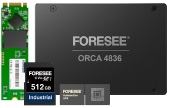
At Lexar Enterprise, memory is more than storage—it is the foundation of reliable system performance. Through our FORESEE™ product brand, we deliver purpose-built memory solutions designed to meet the demands of industrial, embedded, and connected devices operating in real-world conditions. This success story highlights how FORESEE NAND-based MCP helped a wearable device manufacturer overcome space and power constraints—enabling a thinner design, responsive user experience, and efficient power management without compromising performance.
Performance Comparison of UFS Embedded Memory with Other Storage Technologies
Executive Summary
As mobile and portable computing evolves, so does the demand for faster, more efficient storage solutions. That’s why universal flash storage (UFS) was pioneered. Created by JEDEC as a new standard, UFS was built in the pursuit of similar performance levels of embedded storage options. However, every memory technology has its benefits and limitations. In this article, we’ll compare UFS against eMMC, as well as traditional secure digital (SD), microSD and microSD Express cards, highlighting its key performance niches and providing something of a benchmarking standard for the technology.
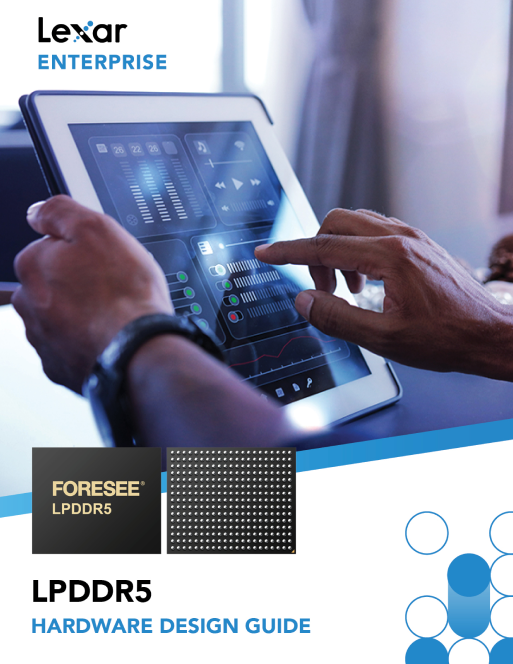
Hardware Design Guide: LPDDR5
Executive Summary
Enhanced signal integrity (SI) and reduced noise for point-to-point or point-to-muti-point applications require a well-designed system board environment. Fortunately, LPDDR5 SDRAM utilizes proven layout and routing techniques for modern embedded and mobile designs using point-to-point interfaces in side-by-side configurations. In this design guide, you’ll get the technical direction to implement LPDDR5 SDRAM to reliably support high-speed/low-power applications.

Hardware Design Guide: LPDDR4/4x
Executive Summary
When correctly configured for embedded applications, LPDDR4 designs provide an attractive alternative to traditional DRAM designs. Signal integrity, power delivery, routing, and decoupling are all major concerns, and LPDDR4 can be used to optimize performance and reduce power consumption in embedded applications.
In this design guide, you’ll get a complete step-by-step walkthrough to properly design and validate high-end LPDDR4 applications for superior stability and functionality.

