
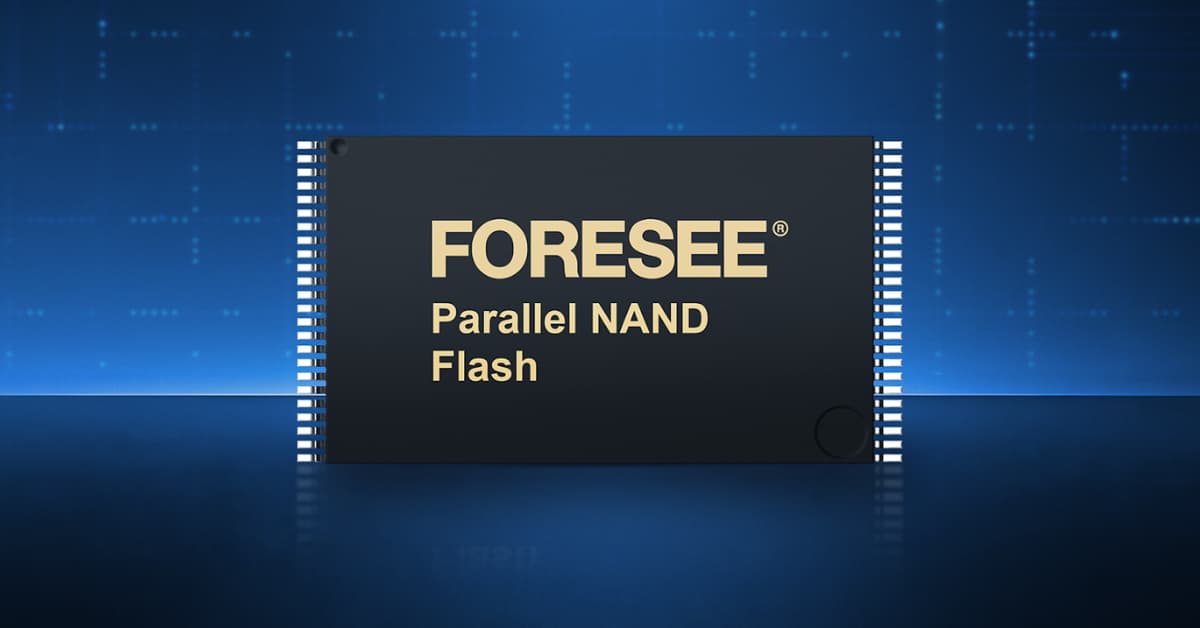
NAND flash memory stores data by trapping electrons in floating gate transistors isolated by thin oxide layers. Each program operation injects electrons through the oxide barrier, while erase operations remove them. This oxide layer experiences physical stress with each P/E cycle, gradually degrading until the cell can no longer reliably maintain charge states.
Modern NAND architectures exacerbate these limitations by increasing bit density. SLC stores one bit per cell, achieving 70,000 to 100,000 P/E cycles. MLC stores 2 bits per cell, reducing endurance to 3,000-10,000 cycles. TLC with three bits per cell drops to 1,000 to 3,000 cycles. QLC with four bits per cell manages only 500-1,000 cycles.
Physical characteristics compound these challenges: cell-to-cell interference from programming adjacent cells; read disturb after thousands of read operations; program disturb, which applies voltage stress to cells sharing wordlines; data retention degradation as charge leaks through oxide layers; and temperature acceleration, reducing retention time at 85°C to 20%-30% of 25°C specifications.
These physical constraints create firmware requirements. NAND controller firmware must distribute P/E cycles evenly, dynamically scale error correction as cells degrade, monitor read and program disturb during refresh operations, and seamlessly replace spare blocks for failed blocks without data loss.
NAND Wear Leveling Algorithms: Dynamic, Static, and Global Strategies
Wear leveling distributes program/erase cycles across all available NAND blocks, preventing scenarios where frequently-written blocks reach endurance limits while rarely-written blocks remain nearly unused. Three wear leveling strategies address different workload patterns.
Dynamic Wear Leveling
Dynamic wear leveling manages only free blocks available for new writes, selecting blocks with the lowest erase counts for incoming data. When the controller receives a write operation, it consults the block erase count table and selects a free block with minimal accumulated P/E cycles.
Dynamic wear leveling operates effectively for workloads with frequent data updates, such as data logging, temporary file storage, or database transaction logs that continuously overwrite existing logical addresses. However, it fails for blocks containing static data.
Configuration parameters, firmware code, and file allocation tables may remain in use for months or years without updates. These “cold” blocks experience minimal P/E cycles, whereas “hot” blocks approach their endurance limits.
Static Wear Leveling
Static wear leveling addresses the cold data problem by proactively moving infrequently written data to more heavily used blocks, freeing low-cycle-count blocks for incoming writes. When the erase count spread exceeds a threshold (typically 100 to 500 cycles, depending on total endurance specification), static wear leveling activates.
The controller identifies blocks containing static data with erase counts substantially below average. Firmware copies this data to blocks with high erase counts, then erases the original low-count block and adds it to the free block pool.
Industrial firmware implementations typically set thresholds at 5%-10% of the total rated endurance. For SLC NAND rated 100,000 cycles, static wear leveling might trigger when any block lags 5,000 to 10,000 cycles behind the highest-count block. Static wear leveling operates as a background task during idle periods when no host I/O operations occur.
Global Wear Leveling
Global wear leveling extends static wear leveling’s scope from individual NAND dies to the entire multi-die storage device. Consumer SSDs and industrial modules typically contain 2 to 16 NAND dies operating in parallel channels. Local wear leveling algorithms manage spare block pools independently for each die.
This local management creates problems because different dies contain varying numbers of factory-marked bad blocks. Under local wear leveling, the die with fewer spares exhausts its spare block pool first, forcing the entire device to be write-protected even as other dies retain hundreds of spare blocks.
Global wear leveling treats all spare blocks across all dies as a unified resource pool. When any die exhausts its local spare blocks, the global algorithm allocates spare blocks from other dies. Practical implementations use hybrid approaches: firmware typically operates with local wear leveling per die, activating global wear leveling only when any die’s spare block count falls below a threshold (typically 10%-20% of the initial spare blocks).
Error Correction Code Architecture and Scaling
Error correction codes detect and correct bit errors occurring in NAND flash due to cell degradation, disturb effects, and charge leakage. ECC strength requirements increase as NAND ages. Fresh cells may generate only 1-2 bit errors per 1KB data page, whereas heavily cycled cells near endurance limits produce 20-50 uncorrectable bits, requiring strong correction algorithms.
ECC Algorithm Evolution: Hamming to LDPC
Early SLC NAND used simple Hamming codes correcting single-bit errors per 512-byte sector. MLC NAND introduced higher error rates requiring Reed-Solomon codes operating on symbols (multi-bit groups) rather than individual bits. Reed-Solomon excels at correcting burst errors, where multiple consecutive bits fail.
TLC and QLC NAND pushed error rates beyond Reed-Solomon efficiency, driving adoption of Bose-Chaudhuri-Hocquenghem (BCH) codes. BCH codes correct multiple random bit errors with lower redundancy overhead than Reed-Solomon for NAND’s typical error patterns.
BCH Code Implementation
BCH codes operate over Galois fields, using polynomial arithmetic to encode data and compute syndromes during decoding. A BCH code specified as BCH(n,k,t) can correct t bit errors in a codeword of n bits containing k data bits and n-k parity bits.
BCH encoding generates polynomial coefficients from data bits, multiplies by x^(n-k), divides by the generator polynomial g(x), and stores the remainder as parity bits concatenated with data bits.
BCH decoding reads the codeword, calculates 2t syndrome values, uses Berlekamp-Massey or Euclidean algorithm to compute error locator polynomial, applies Chien search to find error positions, and flips bits at identified locations. BCH decoder hardware implements these operations in parallel, achieving correction latencies under 100 nanoseconds.
LDPC Code Implementation
Low-density parity-check (LDPC) codes are the current state of the art for NAND error correction. LDPC codes achieve error correction performance approaching the Shannon limit. While BCH codes correct 40-60 bit errors per 4KB page, LDPC implementations correct 100 to 200+ bit errors with similar parity overhead.
LDPC uses sparse parity-check matrices with soft-decision inputs that encode analog voltage levels, indicating bit probabilities. Message-passing iterations implement belief propagation, in which check and variable nodes exchange probability messages. After each iteration, the firmware verifies parity checks. If initial decoding fails, the system adjusts the NAND read-voltage thresholds and retries. Hardware accelerators achieve LDPC decoding in 10 to 100 microseconds.
ECC Strength Scaling Through Device Lifetime
Firmware must adapt ECC strategies as NAND ages. Advanced implementations use multi-tier ECC:
- Initial ECC Layer – BCH codes correcting 8 to 16 bit errors handle normal operation for most of device’s lifetime. Low latency enables full-speed read operations
- Enhanced ECC Layer – Stronger BCH correcting 40 to 60 bit errors activates when initial ECC reports correction near capability limits
- LDPC Rescue Layer – LDPC decoding as a last resort for blocks where BCH fails. High latency limits the use of recovery operations rather than normal reads
Firmware tracks per-block error statistics and escalates ECC strength for blocks that show degradation. This dynamic approach balances performance with reliability as cells age.
Garbage Collection and Write Amplification Control
Garbage collection reclaims NAND blocks containing invalid data, converting them to free blocks available for new writes. This process directly impacts write amplification – the ratio of physical NAND writes to logical host writes. Write amplification determines actual device endurance: a drive rated 100,000 P/E cycles with 3x write amplification achieves only 33,333 logical write cycles before reaching physical endurance limits.
Garbage Collection Mechanics
NAND flash cannot overwrite data in-place. When the host overwrites logical address X, the controller writes data to a different physical block. The old physical block becomes invalid but cannot be erased immediately because it contains valid data for other logical addresses.
Garbage collection identifies blocks with sufficient invalid pages (typically 90-95% efficiency threshold), reads all valid pages, writes valid data to new locations updating logical-to-physical mapping, erases the now-empty block, and adds it to the free pool.
Background vs Foreground Garbage Collection
Firmware can schedule garbage collection as a background activity during idle periods or as a foreground operation that blocks host I/O. Background garbage collection runs when NAND channels are idle and have no pending host operations. However, continuous high-workload applications may provide insufficient idle time for background collection.
Foreground garbage collection activates when the free block count drops below the critical threshold, blocking incoming write operations until sufficient free blocks become available. Industrial firmware implementations set multiple thresholds:
- Background Activation (20%-30% free blocks) – Begin aggressive background collection during idle periods
- Foreground Warning (10%-15% free blocks) – Start opportunistic foreground collection between host operations
- Foreground Emergency (below 5% free blocks) – Force immediate foreground collection, blocking all host writes
Write Amplification Sources and Mitigation
Write amplification arises from garbage collection requiring valid data migration, random write workloads that create many low-efficiency blocks requiring extensive valid page copying (10x to 50x amplification), and mapping table writes that persist logical-to-physical mappings in NAND.
Mitigation strategies include overprovisioning by 7%-28% of physical capacity, separating hot and cold data into separate blocks, using hybrid mapping (block-level for cold data, page-level for hot data), and compaction algorithms that combine multiple low-efficiency blocks into a single operation.
Write Amplification Impact on Industrial Applications
Consider an automotive data logger specification requiring a 5-year lifetime, recording 1GB/day, using 256GB TLC NAND rated for 3,000 P/E cycles. Total host writes = 1.825TB:
- Without write amplification: 7.1 full drive writes, requiring only 21 P/E cycles
- With 10x write amplification: 71 full drive writes = 213 P/E cycles (7% of rated endurance)
- With 50x write amplification from random writes: 356 full drive writes = 1,068 P/E cycles (36% of rated endurance)
Firmware write amplification control transforms identical NAND components into vastly different reliability profiles. Industrial applications must validate write amplification under actual workload conditions rather than assuming optimal values from datasheet specifications.
Bad Block Management and Spare Block Allocation
NAND flash ships with factory-marked bad blocks that failed manufacturing testing, and additional blocks fail during operational lifetime. Bad block management firmware transparently remaps failed blocks to spare blocks, maintaining storage capacity and data integrity.
Factory Bad Block Detection and Runtime Management
NAND manufacturers identify bad blocks during production testing. Failed blocks get marked by writing specific markers to the first page’s spare area. Controller firmware scans all blocks during initial formatting, cataloging bad block locations. Typical NAND specifications allow 2%-5% factory bad blocks. Firmware reserves additional capacity for spare blocks; total overprovisioning typically ranges from 7% to 28%.
Blocks that initially pass factory tests may fail in operation. Firmware monitors status registers during every program and erase operation, watching for program failures, erase failures, ECC threshold exceeding, and read timeouts. When firmware detects new bad blocks, it immediately ceases using the failed block, migrates valid data to spare blocks, and updates the bad block table.
Spare Block Pool Management
Effective spare block management determines device lifetime. Basic implementations maintain separate spare pools for each NAND die (maximizes parallelism but inefficiently handles dies with different failure rates). Advanced firmware treats all spare blocks across all dies as a unified resource. Industrial implementations reserve separate pools for wear-leveling spares (10%-15% of capacity), bad-block replacement spares (2-3% beyond factory bad blocks), and garbage-collection spares.
End-of-Life Prediction and Management
Firmware provides mechanisms for predicting remaining device lifetime:
- SMART Attributes – Self-Monitoring, Analysis, and Reporting Technology exposes wear indicators: spare block count remaining, average erase count, maximum erase count, reallocated block count
- Device Life Estimation – eMMC and UFS standards define lifetime estimation registers indicating the percentage of rated endurance consumed
- Health Descriptor – UFS devices provide health descriptors with estimated lifetime percentage and critical warning thresholds
Industrial applications should monitor these indicators, implement predictive maintenance, and replace storage before reaching critical lifetime percentages.
Lexar Enterprise Firmware Architecture and Reliability Management
Lexar Enterprise industrial storage solutions implement complete firmware architectures addressing wear leveling, ECC, garbage collection, and bad block management for applications requiring extended operational lifetimes.
Multi-Tier Wear Leveling and ECC Implementation
Lexar firmware employs hybrid wear leveling with threshold-based static activation, workload-aware block selection, classifying data into hot/warm/cold categories, and cross-die global pooling, extending device lifetime 20%-40%.
Lexar controllers implement multi-layer ECC: a base BCH layer correcting 16-40-bit errors with sub-100 ns latency; an enhanced BCH layer correcting 60-80-bit errors for degraded blocks; an LDPC rescue layer correcting 120+ bit errors for heavily degraded blocks; and per-block ECC adaptation that tracks error statistics and proactively escalates strength.
Intelligent Garbage Collection and Testing
Write amplification control through efficiency-based block selection (prioritizing >95% invalid pages), background collection scheduling during idle periods, hot/cold data separation, and write amplification monitoring through vendor-specific SMART attributes.
Lexar Enterprise firmware undergoes extensive validation: extended temperature cycling across -40°C to 85°C, power-loss protection testing with atomic mapping updates, accelerated endurance testing to 100% rated cycles, and retention testing at various P/E cycle counts and temperatures.
Technical Support
Lexar Enterprise field application engineers provide workload analysis, custom overprovisioning configurations, ECC threshold tuning for critical applications, and lifetime prediction modeling based on actual workload data and measured write amplification.
Firmware Architecture Determining Product Reliability
NAND flash components provide the physical storage medium, but firmware architecture determines whether industrial storage reaches the specified lifetime or fails prematurely. Wear leveling algorithms must actively distribute P/E cycles across all blocks, not just dynamically-written blocks. ECC must scale from simple Hamming codes for fresh NAND to advanced LDPC for aged cells. Garbage collection must minimize write amplification through intelligent block selection. Bad block management must transparently replace failed blocks utilizing global spare pools.
Engineers selecting industrial storage cannot rely solely on NAND specifications; a 100,000 P/E-cycle SLC rating provides meaningless information without understanding the firmware algorithms that govern how those cycles are distributed, how error correction scales with degradation, and how write amplification amplifies host writes. The same NAND components with different firmware implementations produce vastly different reliability profiles.
Lexar Enterprise firmware architectures implement multi-layered algorithms that transform NAND flash components into industrial storage solutions that meet 5-10-year operational lifetime requirements. Contact Lexar Enterprise field application engineers for firmware analysis specific to your application workload. The right firmware architecture enables your industrial system design; inadequate firmware becomes the reliability bottleneck, leading to premature product failures regardless of NAND component specifications.