
High-performance computing (HPC) applications operate at computational scales that expose the limitations of standard desktop memory systems. HPC workloads process massive datasets, perform complex mathematical operations, and maintain computational state across extended processing cycles that span days or weeks.
Consider the memory demands across HPC application categories:
Engineering Simulation and CAD: Finite element analysis of complex structures requires 64GB to 256GB of active memory to maintain mesh data, boundary conditions, and solution matrices. Computational fluid dynamics simulations processing millions of grid points demand memory bandwidth exceeding 100GB/s to prevent processor starvation.
Artificial Intelligence and Machine Learning: Deep learning model training loads entire neural networks into memory, requiring 128GB to 1024GB capacity, depending on model complexity. AI workloads accelerated by graphics processing units (GPUs) demand memory systems that can feed multiple high-performance graphics processors simultaneously without creating bandwidth bottlenecks.
Scientific Computing and Research: Molecular dynamics simulations, climate modeling, and astronomical data processing handle datasets measured in terabytes, requiring memory systems that maintain computational accuracy through extended calculation cycles lasting weeks.
Standard desktop memory operates effectively for typical office applications, web browsing, and consumer software. However, HPC applications expose memory limitations through system crashes, computational errors, and performance bottlenecks that prevent workstations from delivering their designed computational capability.
DDR5 RDIMM: The Foundation of HPC Memory Architecture
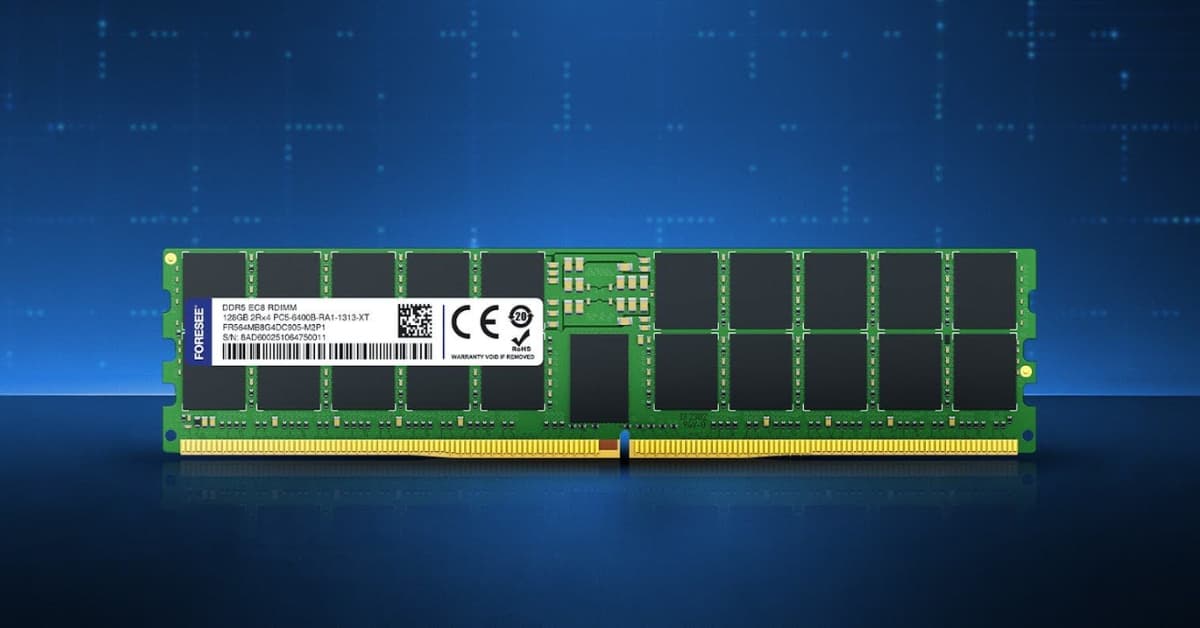
DDR5 registered dual in-line memory module (DDR5 RDIMM) technology represents the current pinnacle of PC memory performance, offering the speed, capacity, and reliability that high-performance computing demands. RDIMM architecture provides significant advantages over standard unbuffered dual in-line memory module (UDIMM) memory through register buffering, enabling higher capacity configurations and improved signal integrity.
DDR5 Performance Advantages:
- Memory Speed: DDR5-4800 to DDR5-6400 providing up to 51.2GB/s bandwidth per channel
- Capacity Scaling: Support for 128GB per module, enabling 2TB+ system configurations
- Power Efficiency: 1.1V operation, reducing power consumption by 20% compared to DDR4
- Channel Architecture: Dual 32-bit channels per module, improving concurrent access patterns
RDIMM Architecture Benefits:
- Signal Integrity: Register buffering enables reliable operation at high speeds with multiple modules
- Capacity Support: Up to eight modules per channel, supporting massive memory configurations
- Electrical Loading: Reduced loading on memory controllers, enabling higher performance scaling
- System Stability: Improved timing margins and signal quality across large memory arrays
Combining DDR5 speed capabilities with RDIMM architecture creates memory systems that can support the most demanding computational workloads while maintaining the stability and reliability that professional applications require.
ECC Error Correction: Critical for Computational Accuracy
Error-correcting code (ECC) memory is essential for high-performance computing applications where computational accuracy directly impacts research results, engineering designs, and business decisions. ECC memory detects and corrects memory errors automatically, preventing data corruption that could invalidate hours or days of computational work.
Memory Error Types and Impact:
Soft errors caused by cosmic radiation, electromagnetic interference, and power supply variations occur naturally in all memory systems. Standard desktop memory experiences approximately one error per 1000 hours of operation, while HPC systems with large memory configurations may encounter multiple errors daily.
These errors manifest as:
- Single-bit errors: Corrupt individual data values leading to calculation inaccuracies
- Multi-bit errors: Destroy data structures, causing application crashes
- Address errors: Redirect memory operations to the wrong locations
- Timing errors: Cause intermittent failures under high-performance conditions
ECC Protection Mechanisms:
ECC memory implements sophisticated error detection and correction algorithms that operate transparently during normal system operation. Single error correction, double error detection (SECDED) capabilities handle most memory errors encountered in typical HPC environments.
Advanced ECC implementations provide:
- Real-time error correction: Automatic correction without impacting application performance
- Error logging: Detailed reporting enabling proactive memory replacement
- Multi-bit detection: Identification of uncorrectable errors before data corruption
- Scrubbing capabilities: Background scanning and correction of dormant errors
We’ve documented computational research projects where single memory errors invalidated weeks of calculation results, highlighting the critical importance of ECC protection for any serious high-performance computing application.
Speed and Bandwidth Requirements for HPC Applications
High-performance computing applications demand memory bandwidth that scales with processor capability and dataset complexity. Memory bandwidth limitations create computational bottlenecks that prevent systems from achieving their designed performance potential, regardless of processor speed or graphics card capability.
Bandwidth Scaling Analysis:
Modern HPC processors integrate 16 to 64 cores capable of processing multiple data streams simultaneously. Each processing core requires consistent memory bandwidth to maintain computational efficiency, creating aggregate bandwidth demands that quickly saturate standard memory systems.
Consider bandwidth requirements across HPC application types:
Engineering Simulation: Finite element analysis requires continuous access to mesh data, material properties, and boundary conditions. Memory bandwidth below 50GB/s creates processor stall conditions that extend simulation runtime by 2x to 3x compared to properly configured systems.
AI Model Training: Neural network training simultaneously loads weight matrices, training data, and gradient calculations. GPU-accelerated training requires memory systems that feed multiple graphics processors, demanding memory bandwidth exceeding 200GB/s for optimal performance.
Scientific Computing: Molecular dynamics and climate modeling applications process time-series data, requiring rapid access to historical states and boundary conditions. These applications benefit from memory configurations that maximize both capacity and bandwidth simultaneously.
DDR5 RDIMM Bandwidth Optimization:
DDR5 RDIMM configurations enable memory bandwidth scaling that matches HPC processor capabilities. Dual-channel DDR5-5600 configurations provide 89.6GB/s theoretical bandwidth, while quad-channel implementations on workstation platforms exceed 179GB/s bandwidth.
Optimal bandwidth utilization requires:
- Channel population: Balanced memory configuration across all available channels
- Speed optimization: JEDEC standard speeds that maintain stability under sustained load
- Timing configuration: Optimized latency settings balancing speed and reliability
- Interleaving: Proper memory interleaving maximizes concurrent access patterns
Critical HPC Applications for High-Performance Memory
Engineering and CAD Workstations
Professional engineering applications, including computer-aided design (CAD), finite element analysis, and computational fluid dynamics, require memory systems that combine high capacity with consistent performance characteristics. These applications load massive datasets while performing iterative calculations that demand stable memory operation throughout extended processing cycles.
Engineering workstations benefit from ECC memory protection, which prevents design errors caused by memory corruption during critical calculations. A single memory error during structural analysis could result in unsafe designs with catastrophic real-world consequences.
Lexar Enterprise DDR5 RDIMM solutions provide the capacity and reliability needed for professional engineering applications. Lexar Enterprise memory modules support the large dataset requirements of modern CAD systems while maintaining the stability and error correction that professional engineering demands.
Artificial Intelligence and Machine Learning
AI workloads represent the most demanding memory applications in modern computing. They require massive capacity to load neural networks while providing the bandwidth needed to feed high-performance GPU accelerators. Machine learning applications cannot tolerate memory errors that corrupt model training or inference results.
Deep learning applications particularly benefit from high-capacity DDR5 RDIMM configurations, which enable entire models to remain memory-resident during training cycles. This eliminates storage I/O bottlenecks, which significantly extend training times and reduce training efficiency.
GPU-accelerated AI workloads require memory systems designed to support multiple high-performance graphics cards simultaneously. Memory bandwidth limitations between CPU and GPU memory create performance bottlenecks that prevent optimal GPU utilization regardless of graphics card capability.
Scientific Computing and Simulation
Scientific computing applications, including molecular dynamics, climate modeling, and astronomical data processing, require memory systems that maintain computational accuracy throughout extended calculation cycles. These applications process datasets measured in terabytes while requiring absolute data integrity throughout weeks-long computational runs.
Scientific applications cannot tolerate memory errors that corrupt research results or invalidate computational conclusions. ECC memory protection becomes essential for maintaining research integrity and preventing the loss of valuable computational time due to memory-related errors.
High-capacity memory configurations enable scientific applications to maintain larger problem sets in active memory, reducing reliance on storage I/O, significantly impacting computational performance in data-intensive research applications.
Lexar Enterprise HPC Memory Solutions
Lexar Enterprise delivers DDR5 RDIMM memory solutions specifically optimized for high-performance computing applications. The Lexar Enterprise HPC memory portfolio addresses the unique demands of computational workloads while providing the reliability and performance that professional applications require.
DDR5 RDIMM Specifications:
- Speed Range: DDR5-4800 to DDR5-5600 with validated JEDEC compatibility
- Capacity Options: 16GB to 128GB per module, supporting multi-terabyte configurations
- ECC Protection: Single Error Correction, Double Error Detection (SECDED) with error logging
- Operating Voltage: 1.1V optimized for power efficiency and thermal management
- Temperature Range: 0°C to +85°C with enhanced thermal design
Professional Performance Features:
- Signal Integrity: Register buffering enabling stable operation in high-capacity configurations
- Timing Optimization: Validated timing parameters balancing speed and reliability
- Quality Assurance: Extended testing ensuring compatibility with professional workstation platforms
- Thermal Design: Enhanced heat spreaders maintain performance under sustained computational loads
Our engineering team works directly with workstation manufacturers and system integrators to validate memory configurations for specific HPC applications, ensuring optimal performance and reliability across diverse computational workloads.
Memory Configuration Optimization for HPC Performance
Successful HPC memory implementation requires a comprehensive understanding of memory architecture, processor capabilities, and application requirements. Optimal memory configurations balance capacity, bandwidth, and reliability within platform architecture and thermal management constraints.
Capacity Planning: HPC applications require memory capacity planning that accounts for dataset size, computational overhead, and operating system requirements. Under-configured memory systems force applications to rely on virtual memory, creating performance bottlenecks that dramatically reduce computational efficiency.
Channel Configuration: Modern HPC platforms support dual-channel, quad-channel, or octa-channel memory architectures. Optimal performance requires a balanced memory population across all available channels to maximize aggregate bandwidth while maintaining memory access efficiency.
Speed Selection: Memory speed selection must balance performance requirements with system stability. Higher memory speeds provide increased bandwidth but may require reduced capacity or compromised stability, depending on platform capabilities and thermal constraints.
ECC Configuration: ECC memory requires platform support and appropriate BIOS configuration to enable error correction features. Proper ECC implementation includes error logging and reporting capabilities that enable proactive memory management and replacement.
Performance Validation and Testing Protocols
HPC memory requires comprehensive validation testing that verifies performance under sustained computational loads and validates long-term reliability under professional usage patterns. Testing protocols must simulate real-world HPC applications rather than synthetic benchmarks that may not reflect actual usage scenarios.
Computational Load Testing: Memory validation requires testing under actual HPC applications, including engineering simulation, AI training, and scientific computing workloads. These tests validate memory performance under real computational stress rather than artificial benchmark conditions.
Thermal Stress Validation: HPC systems operate under sustained high-performance conditions that generate significant heat loads. Memory components must maintain specified performance and reliability under elevated temperatures encountered during extended computational runs.
Error Rate Analysis: ECC memory testing includes a comprehensive analysis that validates error detection and correction capabilities under various stress conditions. This testing ensures ECC protection operates effectively throughout the memory component lifecycle.
Platform Compatibility Testing: HPC memory requires validation across multiple workstation platforms and processor generations to ensure compatibility and optimal performance. Platform testing validates memory timing, voltage, and thermal characteristics across diverse system configurations.
Computational Excellence Demands Memory Excellence
HPC memory modules aren’t just larger-capacity RAM—they’re precision instruments that enable breakthrough discoveries, accelerate engineering innovation, and power the artificial intelligence applications that define technological advancement.
With Lexar Enterprise DDR5 RDIMM solutions, you choose memory technology that matches your computational ambitions, provides the speed and capacity your applications demand, and delivers the ECC protection that safeguards your valuable research and engineering work. Your high-performance computing workloads deserve memory components that eliminate limitations rather than create them.
Transform your computational potential into computational results. Contact Lexar Enterprise to discuss your specific HPC memory requirements and discover how our DDR5 RDIMM solutions enable the performance your most demanding applications require.