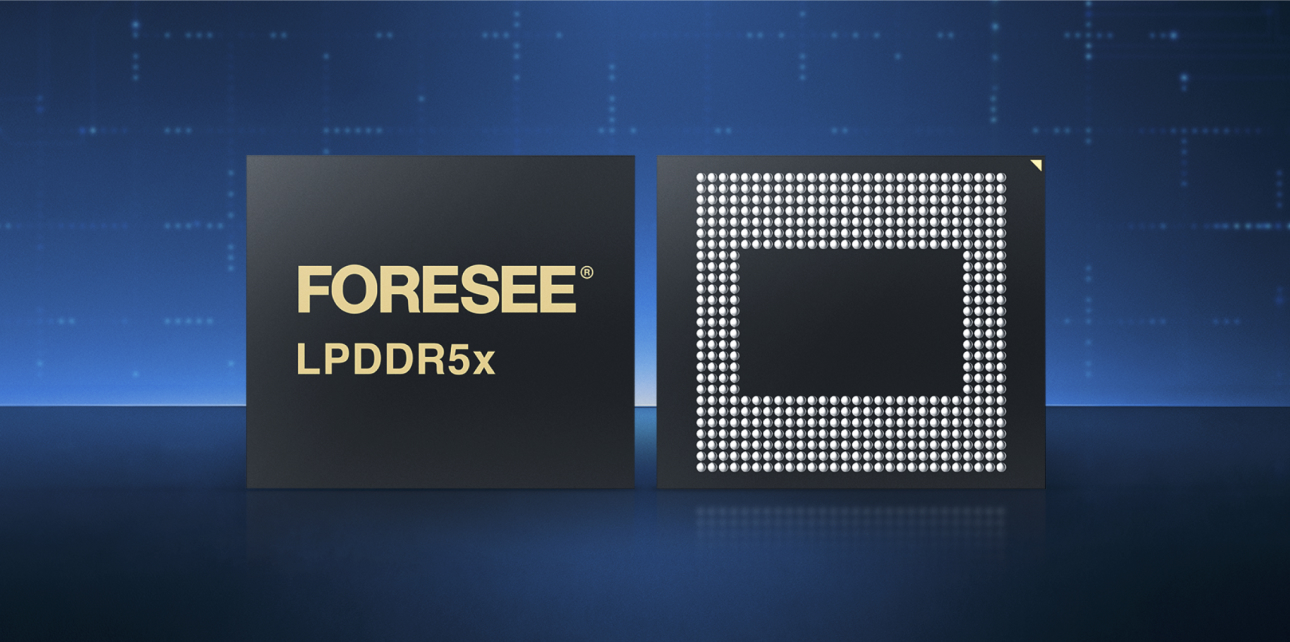


LPDDR5X power consumption improvements come from three architectural enhancements working together. Voltage optimization reduces operating voltage from 1.05V to 1.01V for the data bus (VDDQ), cutting active power by approximately 8% at equivalent transfer rates. Frequency set point (FSP) optimization enables finer-grained dynamic scaling across workload variations, reducing unnecessary power consumption during low-bandwidth periods. Enhanced low-power states improve standby current from 15mW to 10mW per GB in self-refresh mode – critical for edge devices spending significant time in idle states between inference runs.
Active power consumption comparison reveals quantifiable battery life improvements. LPDDR4X operating at 4266MT/s consumes approximately 150mW per GB during sustained memory access. LPDDR5 at 6400MT/s reduces this to 120mW per GB despite 50% higher bandwidth – delivering 20% power efficiency improvement. LPDDR5X at 8533 MT/s maintains 110mW per GB active power, achieving an additional 8% reduction while providing 33% more bandwidth than LPDDR5.
Real-world battery life calculations demonstrate practical impact in edge AI applications. Consider a smart camera running object detection on 1080p video at 30fps. The system uses 4GB LPDDR5X operating at 6400MT/s. Memory active power: 4GB × 110mW = 440mW during inference. Duty cycle: 60% active inference, 40% standby waiting for motion triggers. Average memory power: (440mW × 0.6) + (40mW × 0.4) = 280mW.
The same application using 4GB LPDDR4X at 4266MT/s consumes: (600mW × 0.6) + (60mW × 0.4) = 384mW average memory power. Power savings: 384mW – 280mW = 104mW, representing 27% memory subsystem reduction. In a 5000mAh battery system operating at 3.7V (18.5Wh capacity), this 104mW savings extends battery life by approximately 1.9 hours in an 8-hour target operation window.
Standby current reduction impacts battery life during idle periods when edge devices await triggers or scheduled inference cycles. LPDDR5X deep sleep states consume 2mW to 5mW per GB compared to LPDDR4X’s 8mW to 12mW per GB. For applications spending 80% of time in standby, like industrial IoT gateways performing periodic sensor analysis, standby power dominates total memory consumption.
Dynamic voltage and frequency scaling (DVFS) implementation amplifies LPDDR5X efficiency advantages. Edge AI workloads exhibit variable bandwidth requirements: peak demand during CNN layer processing, moderate demand during model weight loading, minimal demand during pre-processing. LPDDR5X supports rapid frequency transitions (under 10μs) between six FSP points ranging from 3200MT/s to 8533MT/s, allowing memory controllers to match bandwidth delivery to instantaneous demand.
Edge AI Memory Bandwidth and Power Requirements
Edge AI applications create distinct memory access patterns affecting power consumption profiles. Convolutional neural networks for image classification generate burst read patterns loading weight parameters, followed by sustained read/write activity as activation maps pass through layers. A typical MobileNetV2 inference on a 224×224 RGB image requires approximately 300MB total memory transfers, which can be achieved in 50ms using LPDDR5 at 6400MT/s but consuming peak power during that interval.
Object detection models like YOLO increase bandwidth requirements through multiple scale processing. YOLOv5 processing 1080p frames generates 800MB to 1.2GB memory traffic per frame, requiring LPDDR5X bandwidth for real-time 30fps operation. Memory power scales linearly with bandwidth utilization, making LPDDR5X efficiency critical for continuous object detection applications.
Concurrent processing scenarios, like running object detection while streaming video over 5G connection, compound memory bandwidth and power requirements. Video encoding generates additional 400MB to 600MB memory traffic per second at 1080p30. Combined AI inference plus video streaming can exceed 3GB/s aggregate bandwidth, approaching LPDDR5 limits and requiring LPDDR5X headroom.
LPDDR5X Power Consumption Analysis vs LPDDR5 and LPDDR4X
Detailed power consumption analysis across memory generations reveals where LPDDR5X delivers efficiency gains. LPDDR4X at 4266MT/s operates with 0.6V VDDQ, consuming 140mW to 160mW per GB during sustained reads and 180mW to 200mW per GB during writes. LPDDR5 at 6400MT/s increases VDDQ to 1.05V but improves circuit efficiency. Active read power reduces to 110mW to 130mW per GB despite 50% higher bandwidth. Write power drops to 140mW to 160mW per GB.
LPDDR5X at 8533 MT/s maintains similar voltage levels as LPDDR5 but introduces additional circuit optimizations. Active read power: 100mW to 120mW per GB at maximum frequency. Write power: 130mW to 150mW per GB. When operating at 6400MT/s (same as LPDDR5), LPDDR5X consumes 95mW to 110mW per GB, demonstrating 8% to 15% improvement at identical bandwidth.
Standby and self-refresh power states show larger generational improvements. LPDDR4X self-refresh consumes 12mW to 18mW per GB. LPDDR5 reduces this to 8mW to 12mW per GB. LPDDR5X achieves 5mW to 8mW per GB in self-refresh mode, offering a 30% to 40% reduction compared to LPDDR5 and 60% reduction versus LPDDR4X.
Deep power-down states critical for battery-operated edge devices see similar trends. LPDDR4X consumes 8mW to 12mW per GB in deep power-down. LPDDR5 reduces this to 4mW to 6mW per GB. LPDDR5X achieves 2mW to 4mW per GB, enabling edge devices to maintain DRAM content during extended idle periods while minimizing battery drain.
FSP Optimization for Dynamic Workloads
LPDDR5X supports six FSPs enabling dynamic bandwidth and power optimization. FSP configurations span from low-power 3200MT/s to maximum-performance 8533MT/s, with intermediate points at 4266MT/s, 5500MT/s, 6400MT/s, and 7500MT/s. Memory controllers transition between FSPs based on workload demand, reducing power during low-bandwidth periods.
Edge AI workload analysis reveals distinct phases benefiting from FSP optimization. Model initialization requires moderate bandwidth (2GB/s to 4GB/s) suited for 5500MT/s FSP. Inference execution demands peak bandwidth (8GB/s to 12GB/s) requiring 7500MT/s or 8533MT/s FSP. Post-processing needs minimal bandwidth (500MB/s to 1GB/s) operating efficiently at 3200MT/s or 4266MT/s FSP.
FSP transition timing affects optimization effectiveness. LPDDR5X completes FSP changes in 5μs to 10μs – fast enough to track inference pipeline stages without introducing noticeable latency. Power savings from FSP optimization compound with voltage scaling. Operating at 4266MT/s FSP instead of 8533MT/s reduces active power by approximately 45% while still delivering 2× LPDDR4X bandwidth.
Dynamic Voltage and Frequency Scaling (DVFS) Implementation
DVFS implementation in LPDDR5X systems requires coordination between memory controller, power management IC (PMIC), and system software. Memory controllers monitor bandwidth utilization through performance counters. When sustained utilization drops below 60% for more than 5ms, controllers initiate FSP downshift reducing frequency and proportionally lowering power consumption.
Voltage scaling accompanies frequency transitions in properly designed LPDDR5X systems. Operating at 4266MT/s allows VDDQ reduction from 1.05V to 0.95V, cutting I/O power by approximately 18% beyond frequency-based savings. Combined frequency and voltage optimization delivers 50% total power reduction compared to sustained maximum-frequency operation.
AI accelerator integration affects DVFS effectiveness. Neural network inference exhibits predictable execution phases allowing memory controllers to anticipate bandwidth requirements and proactively adjust FSP. Tight coupling between AI accelerator command queues and memory controller performance monitoring enables zero-latency transitions matching inference pipeline demands.
5G Modem Integration and Concurrent Processing Power Budget
5G modem integration in edge devices compounds memory power challenges through concurrent processing requirements. Sub-6GHz 5G modems consume 1.5W to 2.5W during active transmission, with memory bandwidth demands reaching 1.5GB/s for baseband processing. When combined with AI inference requiring 3GB/s to 5GB/s, total system bandwidth exceeds 6GB/s, pushing LPDDR5 to maximum utilization and requiring LPDDR5X headroom.
Power budget allocation in 5G edge devices must account for simultaneous AI and connectivity demands. A typical 5W thermal design power system allocates: 2W application processor + AI accelerator, 2W 5G modem during transmission, 1W remaining for memory and peripherals. LPDDR5X consuming 600mW for 8GB configuration leaves 400mW budget for other components. LPDDR4X requiring 900mW creates impossible power budget constraints.
Temperature-Based Throttling and Thermal Management
Temperature-based throttling becomes critical in LPDDR5X edge devices where compact form factors limit heat dissipation. DRAM junction temperatures exceeding 85°C trigger thermal throttling. LPDDR5X lower power consumption delays throttling onset, maintaining peak performance longer under sustained workloads.
Package-on-package LPDDR5X configurations stacked on application processors face thermal resistance around 15°C/W to 20°C/W. At 800mW memory power dissipation, this creates 12°C to 16°C temperature rise. If a processor runs at 75°C during AI inference, DRAM reaches 87°C to 91°C – triggering immediate throttling in LPDDR4X but remaining within LPDDR5X operating limits due to lower power generation.
Battery Life Impact Calculations for Edge Devices
Complete battery life calculations require system-level power modeling. Consider an industrial IoT gateway with 8GB LPDDR5X, quad-core processor, AI accelerator, and 5G modem. Total system power: 4.5W during active operation, 1.2W during standby, 0.3W during deep sleep. Operational profile: 40% active, 50% standby, 10% deep sleep.
Average power calculation: (4.5W × 0.4) + (1.2W × 0.5) + (0.3W × 0.1) = 2.43W. With 10,000mAh battery at 3.7V (37Wh), runtime: 37Wh / 2.43W = 15.2 hours. Memory contributes: active 800mW, standby 80mW, deep sleep 20mW. Average memory power: 362mW, representing 15% of total system power.
Equivalent system using LPDDR4X: memory active 1200mW, standby 160mW, deep sleep 60mW. Average memory power: 566mW. Total system power increases to 2.63W, reducing runtime to 14.1 hours. LPDDR5X provides 1.1 hour additional operation, a 7.8% battery life improvement from memory optimization alone.
Autonomous mobile robot scenarios amplify battery life impact. A warehouse robot with 20,000mAh battery runs simultaneous SLAM and object recognition. System power: 6W active navigation, 2W idle positioning. LPDDR5X memory: 1.2W active, 120mW idle. LPDDR4X alternative: 1.8W active, 240mW idle. Power savings: 456mW. Runtime improvement: 1.3 hours additional operation per charge cycle.
Low-Power States: Deep Sleep and Standby Current Optimization
Deep sleep state optimization critically affects edge devices spending extended periods awaiting triggers. LPDDR5X deep power-down with DRAM content retention consumes 2mW to 4mW per GB. At 4GB capacity, standby draw totals only 12mW to 16mW, which is negligible compared to processor sleep states consuming 50mW to 80mW.
Self-refresh mode serves intermediate idle periods where deep power-down entry/exit latency proves excessive. LPDDR5X self-refresh at 5mW to 8mW per GB maintains DRAM data with rapid wake capability under 10μs. Edge devices cycling between brief inference runs and 5-second to 30-second idle windows benefit from self-refresh efficiency.
Partial array self-refresh (PASR) enables further optimization by refreshing only actively-used DRAM regions. Edge devices using 2GB of 8GB capacity for active models can configure PASR refreshing only necessary banks, reducing self-refresh power by 75%. LPDDR5X PASR implementation achieves 1.5mW per GB for refreshed regions.
Power Optimization Guide for Edge AI Workloads
Memory configuration recommendations vary by edge AI application category. Computer vision applications processing 1080p at 30fps require 6GB to 8GB LPDDR5X at 6400MT/s FSP balancing bandwidth and power. Natural language processing running transformer models benefit from 8GB to 12GB capacity with 5500MT/s FSP. Multi-modal applications combining vision and language demand 12GB to 16GB at 7500MT/s FSP supporting concurrent model execution.
FSP tuning strategies should match inference pipeline characteristics. Vision models with convolutional layers benefit from aggressive FSP scaling such as maximum frequency during convolution compute, reduced frequency during activation operations. Transformer models exhibit more uniform bandwidth requirements, favoring moderate FSP with minimal transitions.
AI accelerator integration optimizations leverage LPDDR5X capabilities. Accelerators with large on-chip SRAM (2MB to 8MB) can cache model weights, reducing DRAM bandwidth to activation map transfers only. This enables lower FSP operation while maintaining inference throughput. Accelerators with smaller SRAM requiring frequent weight reloading demand higher FSP but benefit from LPDDR5X efficiency at peak bandwidth.
LPDDR5X power consumption delivers 20% to 25% efficiency improvement over LPDDR5 through voltage optimization, enhanced low-power states, and rapid frequency scaling. These improvements enable always-on edge AI applications requiring 8-hour to 15-hour battery operation in mobile robots, industrial gateways, and smart cameras.
Your engineering team should evaluate LPDDR5X for edge AI applications where memory power represents 15% or more of total system consumption. The efficiency gains justify cost premium through extended battery life, reduced thermal throttling, and enablement of bandwidth-intensive models previously impossible in battery-operated form factors.