
Automotive engineers often select storage interfaces based on familiarity or legacy platform constraints rather than matching the interface to the application. However, that creates thermal problems in constrained enclosures. These thermal challenges force costly redesigns when latency-sensitive ADAS or infotainment applications demand response times the original interface cannot deliver.
A clear technical framework helps guide engineers through considerations like latency and throughput comparisons under real automotive workloads. Other considerations include power consumption data across operating states, form factor compatibility with space-constrained enclosures, or environmental qualification data for temperature extremes.
Fortunately, there are some standards to help identify what’s needed in each use, and in this guide, we’ll walk you through them.
The Automotive Storage Interface Landscape
Modern vehicles use several distinct storage interface standards, each suited to different performance tiers and deployment contexts.
embedded MultiMediaCard (eMMC)
eMMC is a NAND flash package with an integrated controller, soldered directly to the board. eMMC uses a parallel bus interface and is common in infotainment head units, instrument clusters, and telematics control units. Key benefits include where cost, compact footprint, and simplicity for specialized devices. eMMC 5.1 delivers sequential read speeds up to 320MB/s and write speeds up to 300MB/s.
Universal Flash Storage (UFS)
UFS uses a serial interface with a command queue architecture. UFS 3.1 achieves sequential read speeds up to 2100MB/s and supports multiple command queues, making it a significant step up from eMMC. UFS is gaining adoption in next-generation infotainment, digital cockpit platforms, and ADAS systems.
SATA SSDs
SATA SSDs primarily appear in automotive applications as discrete M.2 modules in higher-capability systems. SATA III delivers approximately 550MB/s sequential throughput. It is reliable and comes with full automotive temperature qualification. Its AHCI protocol and single command queue create latency bottlenecks in parallel I/O workloads.
NVMe SSDs
NVMe SSDs leverage PCIe lanes with a protocol designed for NAND flash, supporting up to 64,000 command queues. PCIe Gen 3 x4 delivers up to 4 GB/s; Gen 4 reaches 8 GB/s. NVMe is the interface of choice for ADAS data recording, multi-camera systems, and high-performance in-vehicle computing.
BGA SSDs
BGA SSDs are discrete NVMe or SATA storage devices in a ball grid array package, soldered directly to the PCB. They combine discrete SSD performance with the mechanical robustness of a soldered connection to eliminate connector failure modes that affect socketed M.2 modules in high-vibration automotive environments.
Performance Comparison Under Automotive Workloads
| Interface | Sequential Read | Sequential Write | Random IOPS |
| eMMC 5.1 | 320MB/s | 300MB/s | 34,000 |
| UFS 3.1 | 2100MB/s | 1900MB/s | 100,000 |
| SATA III SSD | 550MB/s | 520MB/s | 100,000 |
| NVMe PCIe Gen 3 x 4 | 3500MB/s | 3000MB/s | 500,000 |
| NVMe PCIe Gen 4 x | 7000MB/s | 6500MB/s | 1,000,000+ |
ADAS and multi-camera recording
A system with four cameras at 30fps, LIDAR, and radar telemetry, generate sustained write loads exceeding 1GB/s. eMMC and SATA are disqualified at this throughput level. UFS 3.1 approaches the performance boundary. For full-fidelity multi-sensor recording, NVMe PCIe Gen 3 or Gen 4 is the appropriate interface.
Infotainment and digital cockpit
Systems that load navigation maps, render high-resolution displays, and run concurrent platforms, benefit from the lower latency and higher IOPS found in UFS or NVMe solutions. Storage latency has a direct correlation to application launch times, map rendering, and UI responsiveness.
Telematics and OBD logging
Writing GPS, CAN bus, and diagnostic data followed by extended idle periods, require moderate logging rates that can be met by eMMC and SATA options. NVMe completes burst writes quickly and returns to low-power states, making it energy-efficient for higher-frequency logging.
OTA update storage
eMMC 5.1 can bottleneck OTA write performance on complex vehicle platforms. UFS or NVMe resolves bottlenecks without impacting concurrent system operation. However, it requires enough sequential write bandwidth to receive large firmware packages without blocking other system functions.
Power Consumption in Automotive Designs
1. Active power ranges from under 1 watt for eMMC to 2W–3W for SATA SSDs, 3.5W–8W for NVMe modules, and up to 10W–12W for Gen 4 NVMe under sustained workloads. Raw active power comparisons are misleading. NVMe completes the same operation 4x to 7x faster than SATA, spending less total time at peak power per unit of work done.
2. Idle power is critical in automotive applications where storage may be powered during extended parking or in always-on telematics contexts. eMMC idles below 0.5W. SATA with DevSleep enabled drops below 0.2W. NVMe idle power varies significantly: drives with well-implemented APST and PCIe ASPM idle below 0.05W, while those without proper power state support can idle at 1W–3W. Always verify power state implementation in automotive NVMe selections.
3. Thermal management matters in automotive enclosures with limited or no active cooling. eMMC and UFS generate the least heat and are easiest to manage passively. NVMe drives in confined spaces may require thermal pads or heat spreaders, and must have dynamic thermal throttling to stay within operating limits at elevated temperatures.
Form Factors and Environmental Requirements
eMMC and UFS: Soldered Package Storage
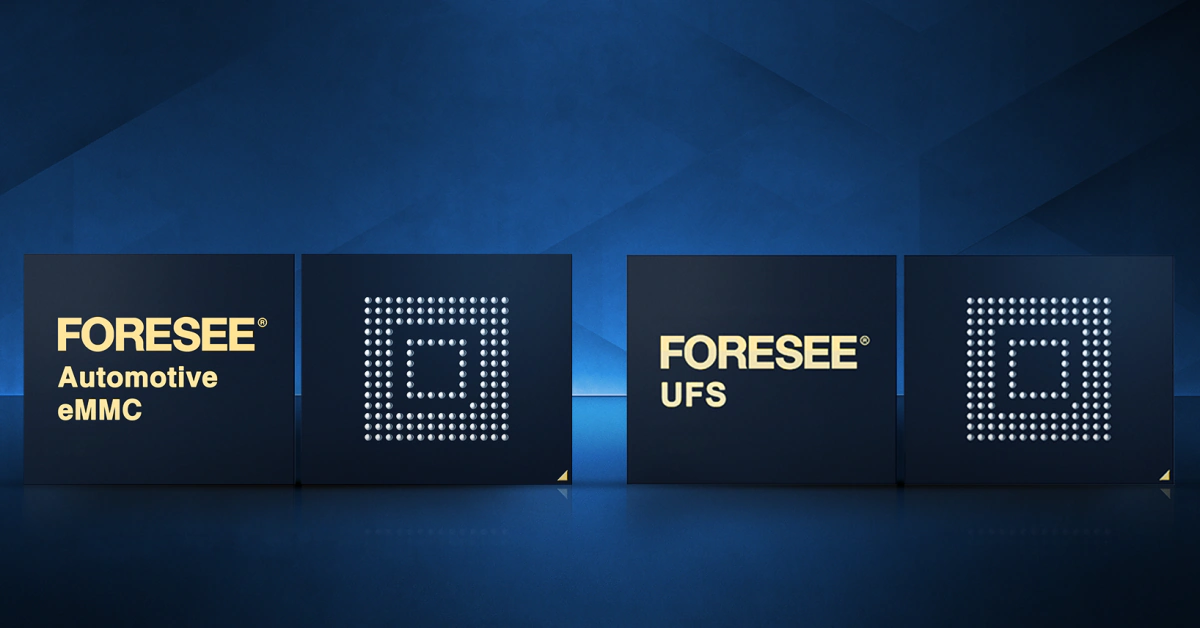
Both eMMC and UFS are available as BGA packages soldered directly to the system board, eliminating connectors entirely and making them inherently resistant to vibration and shock. The tradeoff is that soldered storage is not field-replaceable. Capacity and interface are fixed at the board design stage. Both are compatible with conformal coating and underfill processes for additional environmental protection.
BGA SSDs: Discrete Performance in a Soldered Package
BGA SSDs bring NVMe or SATA controller and NAND flash into a single soldered package, offering discrete SSD performance without the mechanical vulnerability of a socketed connector.
BGA SSDs deliver the highest vibration and shock resistance available in a discrete storage solution, making them well-suited for safety-critical automotive applications. BGA NVMe SSDs typically offer PCIe Gen 3 x4 performance in a package small enough for highly integrated automotive SoC platforms.
M.2 NVMe and SATA Modules
M.2 remains common in automotive platforms where serviceability or sourcing flexibility is required. In automotive deployments, M.2 modules require positive retention mechanisms — a standard retention screw alone is insufficient for severe vibration profiles without additional mechanical support.
Automotive Environmental Qualification
Temperature ranges define the primary qualification tier. Passenger compartment installations require AEC-Q100 Grade 3 (-40°C to +85°C). Under-hood or near-powertrain installations require Grade 2 (-40°C to +105°C) or Grade 1 (-40°C to +125°C). eMMC and UFS devices designed for automotive are commonly available at Grade 2 and Grade 3. Automotive-qualified NVMe and SATA SSDs are typically rated to -40°C to +85°C, with extended temperature variants to +105°C available in a narrower vendor ecosystem.
Shock and vibration qualification follows MIL-STD-810G or IEC 60068-2-6 standards. Automotive drives typically specify 1500G to 1800G non-operating shock and 20G RMS operating vibration. BGA and soldered eMMC/UFS packages outperform socketed M.2 modules in severe vibration profiles.
Power-loss protection is essential for automotive storage. Unexpected power loss during write operations can corrupt data without capacitor-backed protection. Verify that any drive used for safety-relevant data or OS storage includes power-loss protection circuitry.
Additional protections include conformal coating for moisture and contamination resistance, underfill epoxy under BGA components to reinforce solder joints against thermal cycling stress, and wide-temperature-range passive components throughout the storage module.
Interface Selection by Automotive Application
| Application | Interface | Benefits |
| Instrument cluster / simple HMI | eMMC 5.1 | Cost-effective, sufficient bandwidth, compact |
| Infotainment head unit | UFS 3.1 or NVMe | Map rendering and app loading are improved with higher IOPS |
| Telematics / OBD logging | eMMC or SATA | Moderate write rates; low power in idle |
| OTA update storage | UFS or NVMe | High sequential write prevents system blocking |
| ADAS recording (2–3 cameras) | SATA or UFS | Able to process moderate camera counts at 30fps |
| Adas recording (4+ cameras, LIDAR) | NVMe PCIe Gen 3 or Gen 4 | Only interface with sufficient sustained write bandwidth |
| Digital cockpit / SoC platform | UFS or BGA NVMe | Soldered reliability with SSD-class performance |
| Autonomous vehicle computing | NVMe PCIe Gen 4 | Maximum throughput for sensor fusion and recording |
Making the Interface Decision
Automotive storage selection starts with the actual data rate the application generates, the latency the system can tolerate, the temperature range of the installation location, and the mechanical environment the drive will experience. Match those requirements against qualified vendor datasheets rather than interface marketing specifications.
For cost-sensitive, lower-throughput applications such as clusters, basic telematics, or simple HMI, eMMC remains the appropriate choice. UFS 3.1 covers the mid-tier: infotainment, digital cockpit, and moderate ADAS functions. NVMe, in BGA or M.2 form, is the only viable interface for high-fidelity multi-sensor recording and autonomous vehicle compute platforms.
In all cases, prioritize automotive temperature qualification, power-loss protection, and a soldered or mechanically secured form factor appropriate to the vibration profile of the installation location. Lexar Enterprise supports industrial engineers with technical documentation, application-specific performance data, and engineering consultation. Contact Lexar Enterprise field application engineers for consultation on interface selection, thermal management, and validation testing.