
SSD technology has become essential across industries, from autonomous vehicle platforms and manufacturing automation to aerospace avionics and edge computing nodes. A solid-state drive (SSD) is a storage device that uses NAND flash memory to save data electronically – with no spinning disks, no mechanical read/write heads, and no moving parts of any kind. That architecture alone separates SSDs from every hard disk drive (HDD) ever built, and it explains why industrial-grade SSDs now power the most demanding applications on the planet.
For engineers and procurement teams evaluating storage for mission-critical systems, understanding what SSD technology actually is – at the component, interface, and application level – is the starting point for every informed sourcing decision. This guide answers what is an SSD at the component level, how does an SSD work across interfaces and NAND types, what is SSD technology in industrial contexts, and why industrial-grade SSDs differ fundamentally from consumer-grade alternatives.
What Is a Solid-State Drive (SSD)?
A solid-state drive is a data storage device that uses semiconductor-based flash memory to retain data. The term “solid-state” refers to the absence of mechanical or magnetic media – all storage operations happen through electrical charge states within NAND memory cells. This design eliminates the physical latency inherent to rotating platters and makes SSDs faster, more durable, and more energy-efficient than their HDD counterparts in nearly every measurable metric.
SSD full form: Solid-State Drive. To define SSD in technical terms: SSD means a semiconductor storage device where data persistence depends on trapped electrical charges within floating-gate transistors or charge-trap flash cells, rather than magnetic polarization on a spinning disk. Understanding SSD storage meaning goes beyond speed – it describes a fundamentally different storage architecture. The SSD storage meaning for procurement teams is straightforward: a verified reliability tier with direct implications for application uptime and component lifecycle. What does SSD storage mean for an industrial design team? It means replacing the most failure-prone mechanical subsystem in any embedded system with a solid-state component rated for the actual operating environment.
Key characteristics that define what an SSD does in any system:
- Non-volatile storage: Data is retained without continuous power, unlike RAM – this is what is SSD memory at its core. What is SSD memory, specifically? It is NAND flash: a non-volatile semiconductor medium that holds state without a continuous power supply. Industrial SSDs maintain data integrity through power cycles, vibration events, and temperature extremes.
- No moving parts: Eliminating mechanical components removes the primary failure mode of HDDs. Industrial SSDs routinely spec 1,500G shock resistance vs. 300-400G for HDDs.
- Electronic data access: Read/write operations are handled by the SSD controller communicating directly with NAND cells, achieving sub-0.1ms latency vs. 5-10ms mechanical seek times.
- Scalable form factors: SSDs are manufactured across a wide range of physical sizes – from compact M.2 modules for embedded IoT devices to 2.5″ drives for industrial rackmount servers.
- Application-specific engineering: Industrial SSDs add extended temperature tolerance, power loss protection, wear-leveling algorithms, and compliance certifications that consumer drives do not carry.
How Do SSDs Work?
Understanding how does an SSD work – and more specifically, how do SSDs work at the component level – requires looking at two core components operating together. How do SSDs store data: the NAND flash memory array and the SSD controller. Neither functions without the other, and the quality of both determines the drive’s real-world performance and longevity.
NAND Flash Memory Architecture
NAND flash memory is the storage medium inside every SSD. Data is stored by trapping electrical charges in memory cells organized into pages (typically 4KB-16KB each) and blocks (typically 256-512 pages per block). Reading data retrieves charge states from individual pages. Writing data requires erasing an entire block before new data can be programmed – a design constraint that makes write efficiency critical to SSD performance.
NAND comes in five cell configurations, each with distinct tradeoffs between endurance, speed, and cost per gigabyte:
| NAND Type | Bits/Cell | P/E Cycles | Read Speed | Cost/GB | Best For |
|---|---|---|---|---|---|
| SLC (Single-Level Cell) | 1 | 100,000 | Fastest | $$$$$ | Mission-critical industrial |
| pSLC (Pseudo-SLC) | 1 (emulated) | 20,000-30,000 | Fast | $$$$ | Cost-effective industrial |
| MLC (Multi-Level Cell) | 2 | 10,000 | Fast | $$$ | Enterprise mixed workloads |
| TLC (Triple-Level Cell) | 3 | 1,000-3,000 | Moderate | $$ | Read-heavy, consumer |
| QLC (Quad-Level Cell) | 4 | 500-1,000 | Moderate | $ | Archival, read-only |
For industrial applications with write-intensive workloads – think manufacturing data logging, automotive event recording, or edge AI inference – SLC or pSLC NAND is the technically defensible choice. The P/E cycle gap between SLC (100,000) and consumer TLC (~1,000) represents a 100x endurance difference that directly affects drive lifespan and replacement cost over a product’s service life.
The SSD Controller
The SSD controller is the drive’s processing engine. It manages every read, write, and maintenance operation happening across the NAND array. In industrial SSDs, controller firmware handles several critical functions that consumer drives either approximate or ignore:
- Wear leveling: Distributes write operations evenly across all NAND blocks to prevent premature cell exhaustion. Learn how NAND wear leveling firmware manages this at the controller level. Static wear leveling actively relocates infrequently updated data so all blocks age at the same rate. This is defined by the JEDEC JESD218B standard for endurance requirements. See the JEDEC standards body for full endurance specifications.
- Error correction (ECC): Detects and corrects bit errors that accumulate as NAND cells age. Industrial-grade controllers implement advanced ECC algorithms (LDPC – Low-Density Parity Check) capable of correcting multi-bit errors per codeword.
- Garbage collection: Reclaims blocks containing invalid (overwritten) data by consolidating valid pages and erasing freed blocks. Background garbage collection maintains write performance over the drive’s operating life.
- Power loss protection (PLP): Industrial SSD controllers use capacitor-backed power circuitry to complete in-flight write operations during unexpected power failures. Consumer SSDs typically lack this capability, risking data corruption during power events.
- Thermal throttling: Monitors die temperature and adjusts performance to stay within operating limits. Industrial controllers extend this to operate across the full -40°C to +85°C range.
How SSDs Store and Retrieve Data
How do SSDs store data exactly? When data is written to an SSD, the controller identifies available pages in the NAND array, converts data to electrical charge states, and programs those charges into the selected cells. The controller’s flash translation layer (FTL) maps logical block addresses (LBAs) from the host system to physical NAND locations, abstracting the page/block architecture from the operating system.
Reading data is faster than writing because it requires only sensing existing charge states – no erase cycle is needed. The SSD controller addresses the relevant physical pages, reads charge states, runs ECC verification, and returns the data to the host. On a modern NVMe SSD operating over PCIe Gen4, this entire sequence takes under 0.1 milliseconds. On an industrial SSD designed for extended temperature operation, controllers are validated to maintain this performance across the full operating range without compromising data integrity.
SSD vs. HDD: Key Differences
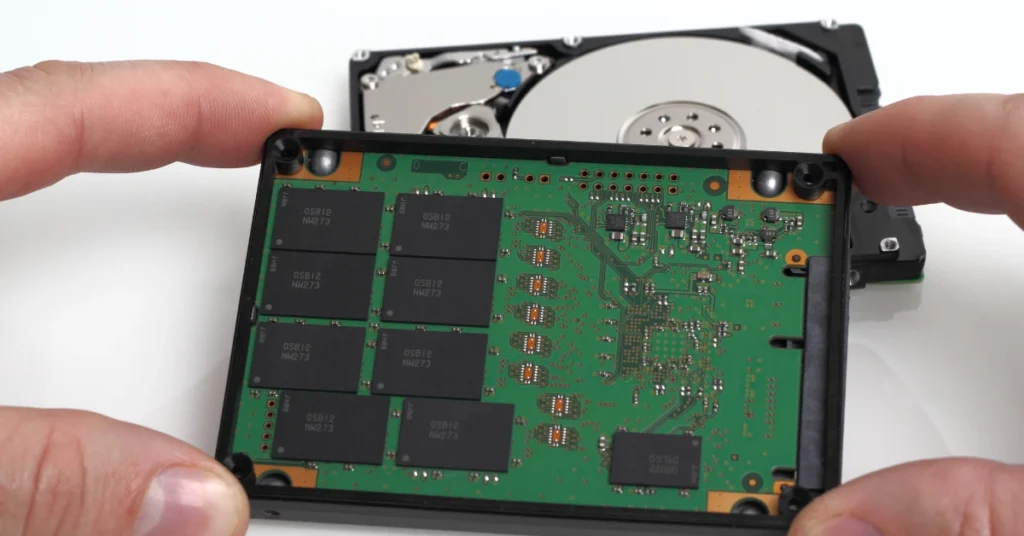
For industrial and enterprise applications, the comparison between SSDs and HDDs is not primarily about price per gigabyte. It is about whether a mechanical storage device can survive the operating environment and meet the latency, endurance, and reliability requirements of the application. In most industrial contexts, it cannot. For a full technical breakdown, see the dedicated SSD vs. HDD comparison guide.
| Feature | SSD | HDD |
|---|---|---|
| Technology | NAND Flash Memory | Spinning Magnetic Platters |
| Sequential Read Speed | Up to 7,000+ MB/s (NVMe PCIe Gen4) | 80-200 MB/s |
| Sequential Write Speed | Up to 5,000+ MB/s (NVMe PCIe Gen4) | 80-160 MB/s |
| Latency | <0.1 ms | 5-10 ms |
| MTBF | 2-5 million hours | 1-1.5 million hours |
| Shock Resistance | 1,500G (industrial grade) | 300-400G |
| Operating Temp (Industrial) | -40°C to +85°C | 5°C to 55°C |
| Power Consumption | 2-5W | 6-15W |
| Noise | Silent | Audible |
| Weight (2.5″) | ~50g | ~115g |
The SSD advantages in industrial deployments extend well beyond speed. The operating temperature range is the defining factor in most sourcing decisions. HDDs are mechanical devices with platters, spindle motors, and read/write heads that cannot function below 5°C or above 55°C without risk of failure. Industrial SSDs – like the FORESEE industrial solid-state drives from Lexar Enterprise – operate across a -40°C to +85°C range, covering the full temperature profile of automotive, aerospace, and outdoor industrial deployments.
For applications like manufacturing automation, vehicle infotainment systems, or outdoor surveillance infrastructure, this is not a performance preference. It is a reliability requirement that eliminates HDDs as a viable option. The SSD vs HDD decision in industrial design is rarely about cost – it is about whether the application can tolerate mechanical failure, thermal limits, and millisecond latency at all.
Types of SSDs: Interfaces and Form Factors
What does an SSD do differently depending on its interface and physical format? Quite a bit. The combination of interface and form factor determines data throughput, physical fit within the host system, and protocol compatibility with the application’s operating environment. For embedded and industrial designs, selecting the wrong combination creates integration problems that are expensive to reverse.
SSD Interfaces: SATA, NVMe, and PCIe
The interface defines how the SSD communicates with the host system’s processor and storage controller. Three interfaces dominate industrial and enterprise deployments:
| Interface | Max Bandwidth | Protocol | Best For |
|---|---|---|---|
| SATA III (SATA SSD) | 600 MB/s | AHCI | Legacy systems, cost-sensitive applications |
| NVMe (PCIe Gen3 x4) | 3,500 MB/s | NVMe | General enterprise workloads |
| NVMe (PCIe Gen4 x4) | 7,000 MB/s | NVMe | High-performance industrial and enterprise |
| NVMe (PCIe Gen5 x4) | 14,000 MB/s | NVMe | Next-gen data centers, AI workloads |
SATA III operates at up to 600 MB/s using the AHCI (Advanced Host Controller Interface) protocol. It is the most widely supported interface and remains appropriate for legacy embedded systems, industrial PCs with SATA backplanes, and cost-sensitive applications where throughput requirements are modest. A SATA SSD offers a significant performance gain over any HDD on the same interface while maintaining backward compatibility with existing hardware.
NVMe over PCIe eliminates the AHCI bottleneck entirely. The NVMe (Non-Volatile Memory Express) protocol was designed from the ground up for NAND flash, with a command queue depth of 65,535 (vs. AHCI’s 32) and significantly lower CPU overhead per I/O operation. The NVMe specification is maintained by the NVM Express organization. For applications processing large sensor datasets, high-resolution video streams, or real-time AI inference at the edge, NVMe is the technically required choice. PCIe Gen4 x4 delivers 7,000 MB/s – nearly 12 times the throughput of SATA III.
For a deeper comparison of these interfaces in industrial contexts, the PCIe NVMe vs. SATA III comparison for embedded and industrial storage covers the tradeoffs in detail. For PCIe-specific SSD specifications and use cases, the PCIe SSD guide covers Gen3 through Gen5 deployment considerations.
SSD Form Factors: Physical Formats for Industrial Deployment
The form factor determines the SSD’s physical dimensions, connector type, and mounting configuration. Industrial deployments span a wide range of space constraints, from compact IoT edge nodes to full-depth server chassis, and each has a corresponding SSD form factor optimized for that environment.
| Form Factor | Dimensions | Interface | Typical Industrial Use |
|---|---|---|---|
| 2.5″ (SFF) | 100 x 70 x 7mm | SATA III / SAS | Industrial PCs, servers, ruggedized systems |
| M.2 2280 (M.2 SSD) | 22 x 80mm | SATA / NVMe | Embedded systems, compact industrial PCs |
| M.2 2242 | 22 x 42mm | SATA / NVMe | Space-constrained IoT devices |
| U.2 | 100 x 70 x 15mm | NVMe | Enterprise servers, data centers |
| mSATA | 50.8 x 29.85mm | SATA III | Legacy embedded systems |
| CFast | 42.8 x 36.4mm | SATA III | Industrial cameras, automation equipment |
| BGA | 11.5 x 13mm | eMMC/UFS | Automotive, mobile industrial |
M.2 SSDs are the default form factor for modern embedded industrial designs. The M.2 2280 (22mm wide, 80mm long) fits the majority of industrial motherboards and supports both SATA and NVMe interfaces through the same connector – with the specific protocol determined by the drive’s key configuration (B-key for SATA, M-key for NVMe, or B+M-key for either). For enterprise server deployments requiring hot-swap capability, the U.2 SSD offers the same NVMe performance in a 2.5-inch compatible chassis with a dedicated PCIe lane – making the U.2 SSD the standard choice for high-density data center storage. For BGA-packaged storage used in automotive and mobile industrial applications, see the related guide on eMMC vs. SSD storage selection.
Why Industrial SSDs Outperform Consumer Drives
The industrial SSD designation is not a marketing tier – it identifies a class of drives engineered to specifications that consumer SSDs are not designed or tested to meet. An enterprise SSD, rugged SSD, or industrial grade SSD built for industrial deployment carries verified SSD endurance ratings, certified operating temperature ranges, and power loss protection that consumer drives simply do not offer. The specification gaps between a commercial consumer drive and a true industrial-grade SSD are significant – and those gaps have real consequences in the field: drives failing at temperature boundaries, data loss during power events, and endurance exhaustion well before the intended product lifecycle.
Extended Temperature Range: -40°C to +85°C
Consumer SSDs are rated for 0°C to 70°C operation. This covers office environments and personal computing scenarios. It does not cover automotive under-hood deployments, outdoor industrial enclosures in winter, manufacturing floors with thermal cycling, or any aerospace application.
Industrial SSDs are tested and rated for -40°C to +85°C operating temperatures. This range covers the full automotive AEC-Q100 Grade 1 temperature profile and the extended industrial temperature range defined by JEDEC standards. At these extremes, NAND flash behavior changes – read/write voltages require adjustment, timing parameters shift, and thermal management becomes active rather than passive. Industrial SSD controllers are specifically validated for this operating envelope. Consumer controllers are not.
Power Loss Protection (PLP)
Unexpected power loss is a routine event in many industrial environments – from vehicle ignition cycles to manufacturing line shutdowns to edge computing nodes without UPS backup. Consumer SSDs handle this inconsistently: some flush write buffers on power loss, others lose in-flight data, and a subset corrupt the drive’s mapping table entirely.
Industrial SSDs with capacitor-backed power loss protection (PLP) use onboard capacitors to supply enough energy to complete all in-flight write operations and flush volatile cache to NAND upon power loss detection. This guarantees data integrity at the storage layer regardless of what happens at the system power level. For applications where data loss represents a safety event – automotive event data recording, medical device logging, energy infrastructure monitoring – PLP is a non-negotiable specification. The guide on industrial SSD power optimizations covers PLP alongside six other power management strategies for demanding deployments.
Higher Endurance: P/E Cycles, TBW, and DWPD
Three metrics define SSD endurance in industrial applications. Understanding all three is necessary for accurate lifecycle costing – and for correctly specifying an enterprise SSD or rugged SSD against the actual write demands of the deployment:
- P/E Cycles (Program/Erase Cycles): The number of times a NAND block can be written and erased before it becomes unreliable. SLC NAND delivers up to 100,000 P/E cycles; consumer TLC delivers 1,000-3,000. For a write-intensive industrial application, this 33-100x endurance gap translates directly to drive replacement frequency and total cost of ownership.
- TBW (Terabytes Written): The total data that can be written to the drive over its rated lifespan. Industrial SSDs carry significantly higher TBW ratings than consumer equivalents at the same capacity point.
- DWPD (Drive Writes Per Day): The fraction of the drive’s rated capacity that can be written each day over the warranty period. A 1 DWPD rating on a 480GB drive means 480GB of writes per day for the warranty period. Industrial write-intensive workloads often require 3-10 DWPD ratings.
Ruggedized Construction and Compliance Standards
Industrial SSDs are built for physical environments that consumer drives are not. Key construction features include:
- Conformal coating: A protective polymer layer applied to the PCB and components that resists moisture, dust, and corrosive contaminants. Critical for outdoor deployments, humid manufacturing environments, and marine applications.
- Wide-temperature NAND selection: Not all NAND flash is rated for extended temperatures. Industrial SSD manufacturers select and screen NAND dies rated for the full operating range.
- Vibration and shock resistance: Industrial SSDs are tested to MIL-STD-810G standards for vibration and mechanical shock. The 1,500G shock specification (operating) is a common industrial SSD rating – significantly exceeding HDD shock resistance.
- MIL-STD-810G compliance: The U.S. Department of Defense’s environmental engineering standard covers testing for temperature, vibration, shock, humidity, altitude, and other environmental stressors. Industrial SSDs certified under this standard have a documented, repeatable reliability baseline for harsh-environment deployments.
For a broader look at how embedded memory handles physical stress and harsh conditions, the guide on embedded memory in harsh environments covers qualification criteria in depth.
FORESEE Industrial SSD Solutions from Lexar Enterprise
Lexar Enterprise’s FORESEE industrial SSD product line is engineered specifically for SSD technology for industrial applications – the full specification stack covered above. FORESEE SSDs are built for automotive, manufacturing, aerospace, and edge computing environments where commercial-grade storage fails to meet operational requirements.
These SSD advantages – extended temperature range, power loss protection, high endurance NAND, and rugged construction – are standard specifications in the FORESEE product line, not optional add-ons. FORESEE industrial solid-state drives are available in 2.5″ and M.2 form factors with SATA and NVMe interfaces, supporting extended temperature operation, power loss protection, and configurable NAND types from SLC through TLC depending on the endurance requirement. For automotive-specific deployments, the FORESEE automotive SSD storage line is validated to AEC-Q100 automotive qualification standards.
Industrial SSD Applications by Sector
SSD technology is not one-size-fits-all. SSD applications span every major industrial vertical, and the storage requirements for an ADAS compute platform are different from those of an industrial automation controller, which are different from a medical imaging workstation. Understanding SSD applications by sector – and what specific SSD uses look like in practice – helps engineering teams identify the right specifications before the selection process begins.
Manufacturing and Industrial Automation
Among the most common SSD uses in industrial settings, manufacturing environments combine high-vibration mechanical operation, wide thermal cycling from cold startups to sustained production heat, and write-intensive data logging requirements. PLCs (Programmable Logic Controllers), CNC machine control systems, and industrial panel PCs all require SSDs that maintain data integrity through power interruptions (common during production line changeovers) and continue operating through temperature ranges that span cold warehouse storage to hot production floor conditions.
Industrial automation applications typically specify an M.2 SSD or 2.5-inch SSD with SATA or NVMe interfaces, SLC or pSLC NAND for endurance, power loss protection, and MIL-STD-810G vibration compliance. See also: memory solutions for industrial automation and robotics.
Automotive: ADAS, Infotainment, and EV Systems
Automotive SSD requirements are among the most demanding in any commercial application. Advanced Driver Assistance Systems (ADAS) generate and process sensor fusion data from radar, cameras, and LIDAR at rates requiring high-throughput NVMe storage. Event Data Recorders (EDRs) demand write reliability through vehicle power events. Infotainment systems require fast boot times and sustained read performance across the full automotive temperature range.
Automotive SSDs must meet AEC-Q100 qualification requirements, which define a stress test methodology for integrated circuits used in automotive electronics. Grade 1 certification covers -40°C to +125°C junction temperatures. For autonomous and semi-autonomous vehicle platforms, automotive-grade SSD storage from Lexar Enterprise covers these requirements with documented compliance testing data.
For a detailed look at memory requirements in ADAS systems specifically, the ADAS memory requirements guide covers the throughput, latency, and endurance specifications that autonomous driving applications demand. The dedicated guide on NAND flash memory for automotive applications covers AEC-Q100 qualification and automotive-specific NAND selection in detail.
Aerospace and Defense
Aerospace and defense applications represent the upper boundary of SSD performance and environmental requirements. Avionics data recorders, flight management computers, and military ground vehicle systems require a rugged SSD that operates across extreme temperature ranges, survives ballistic shock events, resists humidity and altitude effects, and maintains data through power interruptions that would destroy conventional storage. A rugged SSD for defense applications is not simply a consumer drive in a different enclosure – it is a fundamentally different product built to a different specification baseline.
MIL-STD-810G certification is typically mandatory for defense procurement. Secure erase and cryptographic data protection features are commonly required for classified data handling. Supply chain traceability and long-term component availability are critical – defense programs run for decades, and storage components must remain available or have qualified successors throughout the system’s operational life. Lexar Enterprise’s high-reliability memory solutions are designed with this long-horizon availability requirement in mind.
Healthcare and Medical Devices
Medical imaging systems, patient monitoring equipment, and point-of-care diagnostic devices require SSDs that combine high read performance (for rapid image retrieval), write reliability (for patient data recording), and long-term availability for medical device recertification cycles. The regulatory environment for medical devices – including FDA 510(k) clearance requirements – means that storage component changes require revalidation, making long product lifecycle commitments from SSD suppliers a procurement priority.
Edge Computing and IoT
Edge computing nodes deploy in environments far removed from controlled data center conditions: utility substations, transportation hubs, remote agricultural sites, and urban street infrastructure. These deployments face wide temperature ranges, power supply variability, physical vibration, and often extended periods between maintenance access. SSDs for edge IoT applications require the full industrial specification stack: extended temperature, PLP, rugged construction, and ideally remote monitoring capabilities through S.M.A.R.T. data reporting.
For NAND selection guidance specific to edge and IoT power-constrained applications, the guide on choosing SSD NAND for edge applications covers power optimization tradeoffs in detail. For embedded IoT deployments using bare NAND flash rather than full SSD architectures, the embedded NAND flash for IoT guide covers that design path.
Energy and Utilities
Power grid infrastructure, oil and gas monitoring systems, and renewable energy control platforms operate continuously in outdoor industrial environments. Substation automation equipment faces wide temperature ranges, electromagnetic interference, and must maintain data integrity through grid switching events that cause sudden power loss. Industrial SSDs with capacitor-backed PLP and extended temperature ratings are standard specifications for this sector.
How to Choose the Right SSD for Your Application
Selecting the right SSD technology for industrial applications involves a set of specification decisions that cascade from the application’s workload profile and operating environment. The decision matrix below maps common parameters to industrial-grade SSD and industrial grade SSD specifications – covering the gaps that separate a properly specified drive from one that will fail in the field:
| Specification | Consumer SSD | Industrial SSD |
|---|---|---|
| Operating Temperature | 0°C to 70°C | -40°C to +85°C |
| P/E Cycles (TLC) | ~1,000 | Up to 100,000 (SLC) |
| MTBF | 1.5-2 million hours | 2-5 million hours |
| Power Loss Protection | Basic or none | Capacitor-backed PLP |
| Vibration Resistance | Low | MIL-STD compliant |
| Conformal Coating | No | Available |
| Firmware Customization | No | Application-specific |
| Supply Longevity | 1-2 years | 5-10+ years |
| Use Case | Personal computing | Manufacturing, automotive, aerospace, defense |
Key questions that should drive every industrial SSD selection:
- What is the operating temperature range? If the drive will ever operate below 0°C or above 70°C, an industrial-grade rated SSD is required. No consumer drive carries a valid warranty at these extremes.
- What is the write workload intensity? Calculate estimated daily writes (GB/day) and expected product lifetime. Cross-reference against TBW ratings. If the application is write-intensive, SLC or pSLC NAND is the appropriate specification.
- Is power loss a routine event? Any application without a regulated, clean power supply should specify PLP. This includes vehicles, outdoor deployments, and any system without UPS backup.
- What compliance certifications are required? Document the specific standards required (AEC-Q100, MIL-STD-810G, etc.) before evaluating suppliers. Compliance certifications are not retroactively added to drives that were not designed and tested to those standards.
- What is the required supply horizon? Industrial and defense programs often require component availability for 7-10+ years. Confirm supplier roadmap and longevity commitments before committing to a design.
For a structured evaluation framework, the memory specification checklist provides a complete requirements-gathering template covering temperature, endurance, interface, form factor, and compliance criteria. For total cost of ownership modeling across NAND types and endurance tiers, the industrial memory cost and performance guide covers the tradeoff analysis in detail.
For applications where the line between embedded storage and SSD storage is relevant, the eMMC vs. SSD comparison covers the technical and operational tradeoffs between managed NAND solutions and full SSD architectures. The FORESEE industrial SSD product page includes full specifications, certifications, and ordering information.
The Future of SSD Technology
SSD technology is not static. Several developments are actively changing what is possible at the storage layer, with direct implications for industrial and enterprise system designers planning next-generation platforms:
- 3D NAND scaling: NAND manufacturers continue stacking memory layers vertically rather than shrinking cell geometry. 200+ layer 3D NAND is in volume production, enabling higher capacities per die without the endurance penalties that accompanied earlier planar NAND geometry reduction. This extends the viability of TLC and QLC NAND for applications that previously required MLC or SLC.
- PCIe Gen5 adoption: PCIe Gen5 x4 delivers 14,000 MB/s of interface bandwidth – double PCIe Gen4. Industrial and enterprise platforms are beginning to qualify Gen5 SSDs for AI inference workloads and high-throughput sensor data pipelines where Gen4 throughput is the bottleneck.
- Computational storage: Computational Storage Drives (CSDs) – sometimes called a computational SSD – integrate processing capability within the drive itself, enabling data filtering, compression, encryption, and analytics at the storage layer. The computational SSD architecture reduces data movement between storage and compute, This reduces data movement between storage and CPU – a significant efficiency gain for edge AI and analytics workloads where bandwidth between storage and compute is constrained. The SNIA (Storage Networking Industry Association) has published the Computational Storage Architecture and Programming Model specification defining this category.
- CXL (Compute Express Link): CXL enables memory expansion and disaggregation architectures where storage and memory resources are accessible across a standardized coherent interconnect. CXL-attached SSDs can appear as memory-tier resources to host processors, enabling new tiered memory architectures for AI and HPC workloads. For current HPC storage architecture guidance, see the HPC storage solutions guide.
- AI-optimized SSD firmware: SSD controllers are being designed with AI inference workload patterns in mind – specifically the random read access patterns of large language model weight loading and the write patterns of AI training checkpoints. Firmware optimized for these patterns delivers better sustained throughput than general-purpose SSD firmware under AI workloads.
Frequently Asked Questions
What is an SSD in simple terms?
What does SSD storage mean? A solid-state drive (SSD) is a storage device that uses NAND flash memory to save data electronically. Unlike hard disk drives (HDDs), SSDs have no moving parts, which makes them faster, more durable, and more energy-efficient. Industrial SSDs extend these benefits with features like extended temperature tolerance and power loss protection for mission-critical applications.
How does an SSD store data?
SSDs store data by trapping electrical charges in NAND flash memory cells. The SSD controller manages read and write operations, distributing data across memory cells using wear-leveling algorithms to extend the drive’s lifespan. Data is organized into pages and blocks within the NAND architecture. Reading data retrieves charge states from pages; writing requires erasing an entire block before new data can be programmed into it.
What is the difference between SSD and HDD?
The SSD vs HDD question comes down to architecture and operating environment. The core difference is that SSDs use flash memory with no moving parts, while HDDs use spinning magnetic platters with mechanical read/write heads. SSDs deliver faster read/write speeds (up to 7,000+ MB/s on PCIe Gen4 NVMe vs. 80-200 MB/s on HDD), better shock resistance (1,500G vs. 300-400G), lower power consumption (2-5W vs. 6-15W), and silent operation. In industrial contexts, the operating temperature range is the critical differentiator: industrial SSDs operate from -40°C to +85°C, while HDDs are limited to 5°C to 55°C.
What are the different types of SSDs?
SSDs are defined by interface and form factor. Interfaces include SATA III (up to 600 MB/s), NVMe over PCIe Gen3 (up to 3,500 MB/s), PCIe Gen4 (up to 7,000 MB/s), and PCIe Gen5 (up to 14,000 MB/s). Form factors include 2.5-inch, M.2 2280, M.2 2242, U.2, mSATA, CFast, and BGA. Industrial applications most commonly use M.2 or 2.5-inch SSDs with NVMe or SATA interfaces, selected based on the host system’s connector and the throughput requirement.
What is the difference between industrial and consumer SSDs?
Industrial SSDs are engineered for extreme environments with extended temperature ranges (-40°C to +85°C vs. 0°C to 70°C for consumer), higher endurance (up to 100,000 P/E cycles with SLC NAND vs. ~1,000 for consumer TLC), capacitor-backed power loss protection, conformal coating for moisture and contamination resistance, and compliance with standards like MIL-STD-810G. Consumer SSDs are optimized for cost-effectiveness in personal computing scenarios and do not carry these specifications.
What does SSD stand for?
SSD full form: Solid-State Drive. SSD means a semiconductor-based storage device with no moving parts. SSD stands for Solid-State Drive. The term “solid-state” refers to the use of semiconductor-based flash memory rather than mechanical or magnetic storage media. This design eliminates moving parts, resulting in faster data access speeds and greater physical durability compared to hard disk drives.
How long do industrial SSDs last?
Industrial SSDs are rated for significantly longer operational lifespans than consumer drives. Key longevity metrics include MTBF (Mean Time Between Failures) of 2-5 million hours and TBW (Terabytes Written) ratings that reflect the total write capacity over the drive’s life. SLC-based industrial SSDs handle up to 100,000 program/erase cycles per block. For specific application lifecycle planning, DWPD (Drive Writes Per Day) is the most useful metric – it directly relates the drive’s rated endurance to the application’s expected daily write volume.
What NAND flash type is best for industrial applications?
SLC (Single-Level Cell) NAND offers the highest endurance and reliability for write-intensive industrial workloads – rated to 100,000 P/E cycles. pSLC (Pseudo-SLC) provides a cost-effective alternative with 20,000-30,000 P/E cycles by operating MLC or TLC NAND in single-bit mode. MLC is appropriate for enterprise mixed-use workloads with moderate write intensity. TLC is suitable for read-heavy applications where cost per gigabyte is a priority and write volumes are low. For detailed guidance on NAND type selection, the NAND flash SLC vs. MLC vs. TLC vs. QLC comparison for industrial applications covers the full tradeoff analysis.